
Emma Whitfield, Beauty Editor.
The bathroom shelf tells its own story: four half-used tubes in nearly the same shade of rose, each bought after the last one ‘wore off by lunch’. The question typed into a search bar late at night is usually some version of why doesn’t my lipstick last, and the honest answer has less to do with willpower or coffee cups than with a handful of things a label rarely explains. This guide is about learning to judge a long-wear lipstick the way a formulation chemist would, so the next tube you choose is chosen on evidence rather than a promise printed on the box. One fact worth knowing before anything else: most long-wear formulas lean on the same small family of film-forming ingredients, and the difference between a good one and a disappointing one usually comes down to how well those ingredients are balanced, not how exotic they sound on the packaging.
- Wear time depends on chemistry, not price: the film-forming ingredients that make a lipstick stay put are inexpensive; costly tubes mostly buy packaging and marketing.
- A five-minute tissue test at home beats any claim on the box: transfer resistance is measurable before you ever leave the house.
- Application technique changes wear time more than formula does: how you prep and set the colour can add hours to how long it lasts.
Why Long-wear Formulas Behave Differently On Your Lips
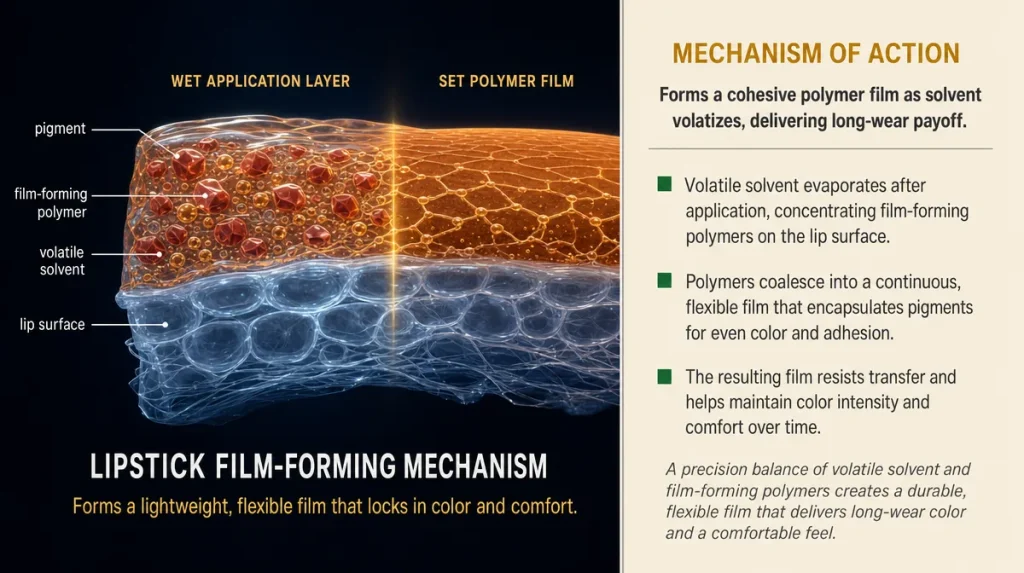
A traditional cream lipstick behaves like wet paint: it sits on the surface, looks glossy, and transfers onto anything it touches, a glass, a collar, a cheek. A long-wear formula is closer to a quick-drying paint that forms a thin, flexible film once it makes contact with air and warmth. That film is usually built from silicone resins or film-forming polymers, sometimes combined with volatile solvents that evaporate within a minute or two of application, leaving the pigment locked to a thin plastic-like layer on the lip.
This is why long-wear lipsticks often feel wet on application and then set to a drier, more matte finish. The setting stage is not a flaw, it is the mechanism doing its job. A 2021 paper presented at an IFSCC congress on lip-product film formation described this two-stage behaviour as central to transfer resistance, noting that formulas which skip a genuine drying phase tend to smudge regardless of their marketing claims.
Understanding this mechanism changes how you should judge a product. A lipstick that never feels like it is ‘setting’ in the first few minutes after application is unlikely to resist transfer later, no matter what the label promises.
Finding Your Undertone And Depth In Daylight
Shade-matching under shop lighting is one of the most common ways a lipstick ends up unworn. Fluorescent and warm indoor bulbs distort colour, sometimes shifting a shade a full step warmer or cooler than it will appear outdoors.
The simplest fix is to test on the lip itself, not the back of the hand, and to look at it near a window in natural light rather than under a mirror light. Lip skin tends to sit slightly darker or more pigmented than the inner wrist, so a swatch there is a closer approximation of the finished look.
Describe depth in words rather than chasing a specific brand’s naming system: a lipstick that reads as light-to-medium on fair skin may read as noticeably lighter on deeper skin tones, since underlying pigmentation always shows through a sheer or satin finish more than a fully opaque one. For genuinely long-wear formulas, opacity tends to be higher because the pigment load must survive hours of contact, so shade shifts across skin tones are usually smaller than with sheer balms, though not absent.
Self-test: apply a small stripe along the natural lip line, wait two minutes, then check the colour by a window rather than a bathroom mirror. If it looks markedly different from the way it appeared indoors, it will likely surprise you again later in the day.
The Five-minute Transfer Test You Can Run At Home
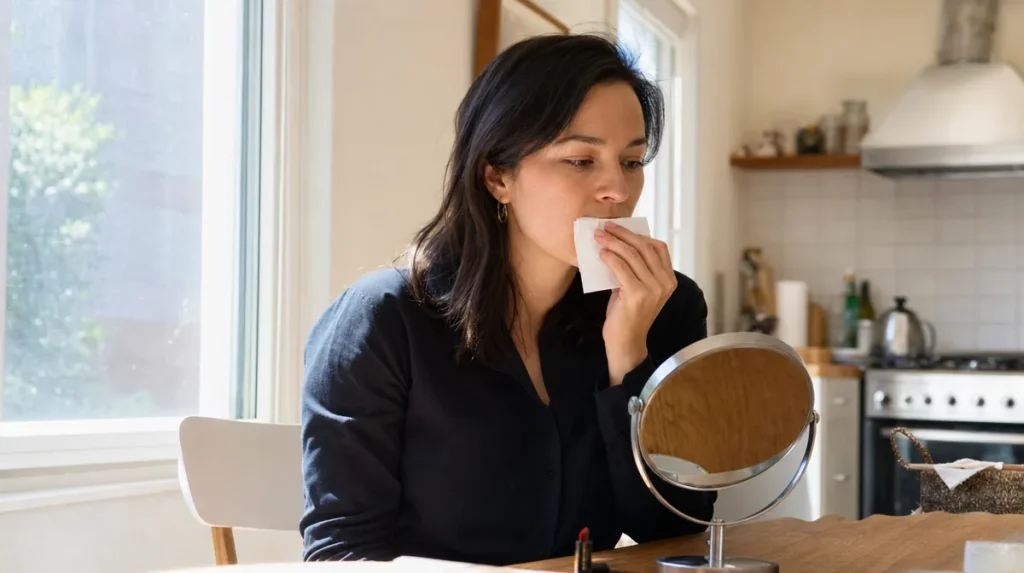
Retailers rarely let you wear a lipstick for eight hours before buying it, but you can approximate the most useful part of that test in under five minutes. Apply the lipstick as you normally would, wait two minutes for it to set, then press a clean tissue or the back of your hand firmly against your lips once.
A formula built for genuine wear time will leave little to no colour on the tissue after that first press. A formula that is mostly marketing will leave a visible mark, and often several marks if you repeat the press.
This single test correlates reasonably well with real-world transfer resistance, because the mechanism being tested, whether the film has actually formed, is the same mechanism responsible for staying on a coffee cup or a face mask later in the day. It will not tell you how a colour behaves after a meal, since oils from food can still break down a film-forming layer, but it separates products that never had a working film from those that do.
A quiet, useful habit: keep a small note on your phone of which formulas pass this test and which do not, since testers are rarely returned to and memory fades faster than colour does.
What ‘Up To 24 Hours’ Actually Means, And What It Doesn’t
Wear-time claims printed on packaging are almost always based on a controlled laboratory measurement, not a normal day. A common method involves applying the product to a panel of volunteers under standardised conditions, then measuring colour retention at intervals without eating, drinking, or touching the lips.
That is a legitimate way to compare formulas against each other, but it does not resemble a workday with three coffees, a lunch, and a mask worn on public transport. Consumer Reports has published general guidance in the past noting that laboratory wear claims for cosmetics tend to represent a best-case scenario rather than an average one, a caution worth applying to any ‘up to’ figure.
The more useful number, if a brand publishes it, is the percentage of colour retained after a defined activity such as eating a meal, rather than a headline hour count. Few brands disclose this, which is itself informative: a formula confident in real-world performance usually says more, not less, about how it was tested.
Treat ‘up to 24 hours’ the way you would treat ‘up to 500km’ on a fuel efficiency label: technically achievable under ideal conditions, rarely the number you will actually get.
Where Inexpensive Formulas Actually Cut Corners
The cost difference between a modestly priced long-wear lipstick and a premium one rarely lies in the core film-forming chemistry, which is broadly similar across price points. It tends to show up in three places instead.
First, pigment dispersion: cheaper processing can leave pigment unevenly distributed through the base, producing a patchy first application that needs a second coat to look even. Second, plasticisers and emollients that keep the dried film flexible are sometimes reduced to cut cost, which can make a formula feel tight, crack along lip lines, or flake after several hours rather than wearing down evenly. Third, fragrance and flavour masking, since raw film-forming polymers can taste unpleasant, and a cheaper masking system may fade quickly, leaving an off taste that better-funded formulas manage more successfully.
None of this means an inexpensive lipstick is automatically poor, or that an expensive one is automatically well made. It means the specific failure modes worth checking for, patchiness on first swipe, cracking after a few hours, an unpleasant aftertaste, are the same regardless of price, and checking for them yourself is more reliable than trusting the number on the shelf.
Application Technique That Outperforms The Formula Itself
Two people using an identical lipstick can get very different wear times, and the gap usually comes down to preparation and layering rather than luck.
Exfoliating dry, flaking skin before application matters more than most people expect, since a film-forming lipstick adheres to loose skin as readily as to the lip surface itself, and that loose skin is the first thing to lift off. A thin layer of a plain, fragrance-free lip balm applied a few minutes beforehand and blotted, rather than left wet, gives the film something even to grip.
Building colour in two thin layers, blotting with a tissue between them, outperforms one thick layer almost every time. The blotting step removes excess product that would otherwise smear rather than set, and the second thin layer fills in any patchiness left by the first.
Finally, resist the instinct to reapply the moment colour looks slightly lighter. Many long-wear formulas fade in two stages: an outer layer wears first, leaving a stained under-layer that can look uneven but is often still doing its job. A light touch-up of colour alone, without stripping the stained base with balm or a wipe, usually restores the look faster than starting over.
How To Judge Fading Honestly, And When To Touch Up
Fading is not a single event, it happens unevenly across the lip, and knowing what pattern to expect helps you judge a formula fairly rather than blaming it too early.
The centre of the lower lip, which meets cups, straws, and food most directly, fades first, sometimes within two to three hours even on a strong formula. The outer edges and lip line, protected from most contact, can retain colour for considerably longer, which is why a lipstick can look patchy well before it has actually failed.
A fair way to judge a formula’s real performance is to look at the outer lip line after several hours rather than the centre. If pigment has held there, the formula is doing its intended job even if the centre needs a touch-up, since no lipstick, regardless of claims, is designed to survive direct food contact indefinitely.
A touch-up is not a sign of failure. Reapplying colour to the centre alone, roughly at the point when the two areas start to look visibly mismatched, is standard practice even among people who wear long-wear formulas daily, and doing it once during a normal day is a realistic expectation rather than a disappointment.
Reading The Ingredient List Without A Chemistry Degree
An ingredient list on a lipstick can look intimidating, but a handful of terms tell you most of what matters for long wear.
Look near the top of the list for silicone-derived ingredients ending in -siloxane or -methicone, or for terms like trimethylsiloxysilicate, which are common film-forming agents. Their presence, especially high in the list, is a reasonable signal of genuine long-wear engineering rather than a sheer, quickly fading formula.
Emollients and plasticisers further down the list, ingredients such as isododecane or various esters, help keep the dried film flexible rather than brittle, which matters for comfort and for resisting the cracking mentioned earlier. Their absence in an otherwise heavily film-forming formula is one reason some long-wear lipsticks feel drying.
Be wary of marketing terms that sound scientific but describe nothing measurable, phrases like ‘bio-active complex’ or ‘molecular lock technology’ rarely correspond to a specific, checkable ingredient. The American Academy of Dermatology’s general public guidance on cosmetic labelling notes that marketing language on packaging is not regulated the way active ingredient lists are, which is a useful reminder to judge the ingredient list itself rather than the name given to it.
Caring For Lips That Wear Long-wear Formulas Daily
A film-forming layer that resists transfer also resists moisture exchange to some degree, which is part of why long-wear lipsticks are more commonly associated with dryness than ordinary balms or glosses.
A 2019 study in a dermatology journal on lip barrier function found that repeated use of strongly film-forming lip products, without a recovery period, was associated with increased transepidermal water loss on the lip compared with periods of no product use, though results varied by formula and individual. That does not mean long-wear lipstick should be avoided, but it does support a simple habit: removing colour fully at the end of the day with a proper lip-safe remover rather than letting it wear off on its own, followed by a fragrance-free, occlusive balm overnight.
A clinical pharmacist’s general caution worth carrying into your own routine, cited in hospital and retail pharmacy contexts, is that cracked or persistently sore lips should not be treated with more lipstick or more balm layered on top, since this can trap irritants against already compromised skin. If a formula reliably leaves lips sore or flaking within a day, that is a formulation issue worth switching away from, not a personal-tolerance problem to push through.
Key Takeaways
Long-wear performance comes down to a film-forming mechanism that behaves the same way across price points, so testing the formula yourself tells you more than the price tag or the claim on the box. A five-minute transfer test, checked in daylight and judged fairly against how lips actually fade, is more reliable than any marketing language. Application technique, particularly thin layers and proper preparation, changes wear time as much as the formula itself, and a proper end-of-day removal habit protects the lips from the drying effect that strong film-forming formulas can bring.
A Quick Checklist Before You Buy
- Swatch on the lip itself, checked in daylight near a window, not under shop lighting
- Run the tissue press test after two minutes of setting time
- Check the ingredient list for silicone-derived film-formers near the top and emollients further down
- Be sceptical of hour-count claims with no real-world context behind them
- Prep lips with a thin, blotted balm layer before applying colour
- Build colour in two thin layers rather than one thick one
- Judge fading by the outer lip line, not just the centre
- Remove fully at day’s end and follow with a fragrance-free balm
This article is general information and does not replace personalised advice from a pharmacist or dermatologist.
Individual results vary by skin type, lip condition and how a product is applied.