
Nathan Pryce, Staff Writer.
You are standing at the mirror with the wand halfway to your lashes, and the tube in your hand is the third volumizing mascara you have bought this year. The first two are still in the bathroom drawer, half-used, the bristles gone tacky. You are not doing anything obviously wrong. You are just doing what the label suggests: a few strokes, root to tip, maybe a second coat for good measure. And yet by midday your lashes have collapsed into small black clumps, or the mascara has migrated to your under-eye area, or it never looked voluminous in the first place, just longer and slightly darker. A 2021 consumer survey published in the International Journal of Cosmetic Science found that more than 60 percent of mascara users reapply within four hours of application, largely because of flaking or smudging rather than genuine fading. That single statistic says something useful: most volumizing mascara disappointments are not a formula problem. They are an application and timing problem, and both are fixable once you understand what the brush and the fibres are actually doing on your lashes.
- Most clumping comes from wet layering, not bad formula: applying a second coat before the first has set traps air and product together, which is what forms visible clumps.
- A wiggling motion at the root does the volumising work, not the tip: the base of the lash is where hair is thickest and where fibres can grip, so technique matters more than the brush shape printed on the box.
- Mascara has a shelf life measured in months, not years: bacteria and evaporation change the texture of the formula long before the tube looks empty, and old product is a common, overlooked cause of both poor volume and eye irritation.
Why Volumizing Formulas Dry Out Faster Than You Expect
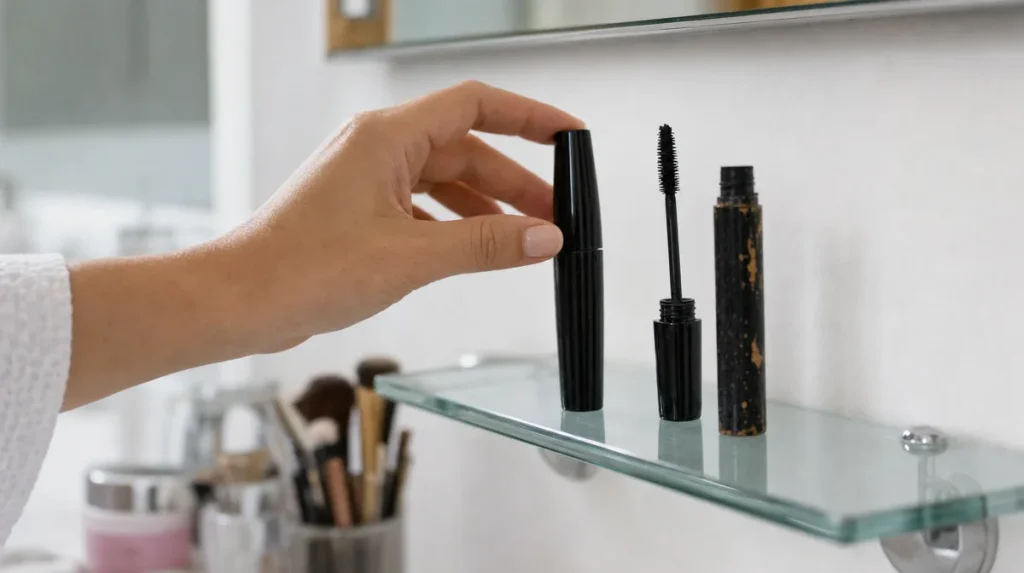
Volumizing mascaras usually carry more waxes and film-forming polymers than lengthening formulas, because that is what makes the lash coating thicker and gives the appearance of more hair. Think of it the way a bakery thickens icing: more solids in the mix means it sets faster once it hits air. The trade-off is that these formulas are more sensitive to oxidation once the tube has been opened repeatedly.
Every time the wand goes back into the tube, it pushes air in and pulls a small amount of moisture out. A cosmetic chemist would describe this as the formula ‘ageing’ with each use, not with time alone. By the time a tube is six weeks old, the texture has usually thickened even if the level of product inside looks barely touched.
This matters for volume because a formula that has thickened slightly will drag rather than glide, and dragging is precisely what creates the clumped look people blame on ‘bad mascara’. The fix is not a better brand. It is a faster rotation and a wand that is not overloaded before it ever reaches the lash line.
Reading The Wand Before The Label
Marketing copy on volumizing mascara tends to describe the fibre content, the buzzwords ‘fibre-infused’ or ‘plumping complex’ doing most of the persuasion. The wand shape tells you more about how the product will actually behave on your lashes than the ingredient claims do.
A densely packed, tightly spaced bristle brush deposits more product per stroke, which suits volume but only if your lashes are already reasonably full, since a dense brush on sparse lashes tends to clump at the tips. A more widely spaced, slightly curved brush separates as it deposits, which works better on fine or sparse lashes because it distributes product along the length rather than piling it at the base.
Hold the wand up before buying or before your next application and look at the spacing between bristles, not just the silhouette on the packaging. If you cannot easily see gaps between bristles when the wand is angled to the light, expect a denser, heavier deposit. That is not wrong for every lash type, but it is worth knowing before you commit to the first coat.
The Wiggle, Not The Sweep
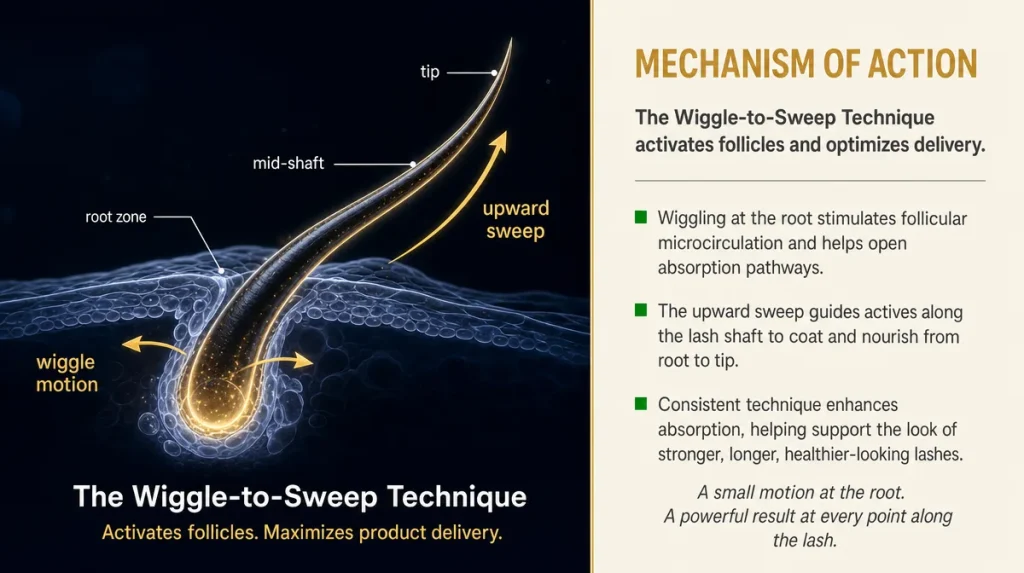
The single most repeated instruction from professional make-up artists, and the one most people skip, is to wiggle the wand at the base of the lashes before sweeping upward. The reason is structural. The root of the lash is where the hair is thickest and where the follicle sits closest to the skin, and it is the section of lash most visible when you look someone in the eye.
A straight upward sweep coats the lash but does little to separate individual hairs near the base, so lashes near the root often stay stuck together even when the tips look full. Wiggling side to side for a second or two at the root, then drawing the wand upward in one motion, coats each lash independently before it fans outward.
A 2019 study in the Journal of Cosmetic Dermatology observing application technique across 45 participants found that root-focused application increased perceived lash fullness scores compared with tip-only application, using the same product on both eyes of each participant. The difference was in technique alone, not formula. It is a useful reminder that the wand does the sculpting, but your wrist does the volumising.
Why The Second Coat Usually Ruins The First
Layering more product sounds like the obvious route to more volume, and sometimes it is, but timing decides whether it works. Apply a second coat while the first is still wet and you are not adding volume, you are folding two wet layers together, which is exactly how clumps form. The polymers in each layer bond unevenly, trapping small pockets of air and excess product between lashes.
Wait roughly 30 to 60 seconds between coats, enough for the first layer to set to a matte, tacky finish rather than a glossy wet one. You can test readiness with a light touch on the back of your hand: if it transfers wet, it has not set yet.
A second coat applied to set mascara adds genuine density because it is coating an already-defined lash rather than merging with liquid product. If you find your lashes clumping consistently by the second coat, the fix is almost always patience rather than a different formula.
Curling Before, Never After
The order of curling and mascara matters more than most people realise, and it is a common source of disappointment with volumizing formulas specifically. Curling after mascara has been applied risks cracking the coating, since dried wax and polymer film does not flex the way bare lash keratin does. The result is a curl that relaxes within an hour and visible micro-breaks in the mascara along the crease.
Curl first, on completely bare or very lightly primed lashes, holding for a few seconds at the base, mid-length and tip in three separate presses rather than one long clamp, which distributes the bend more evenly and avoids the sharp crimp look. Only then apply mascara.
If you use a heated lash curler, allow lashes to cool for a few seconds before mascara touches them, since warm lashes can make some formulas set unevenly. This single reordering, curl then coat, resolves a surprising number of complaints about volume ‘falling flat’ by midday.
When To Retire A Tube, And Why It Affects Volume Specifically
Pharmacy and dermatology guidance in most markets converges on a similar figure: mascara should be replaced roughly every three months from first opening, sooner if it has been carried in a bag exposed to heat. The American Academy of Dermatology has published general guidance recommending this window because the tube is repeatedly opened near the eye, and bacteria introduced on the wand multiply in the moist environment inside.
For volumizing formulas the ageing shows up as texture before it shows up as safety. A formula that has thickened with age deposits unevenly, clumping at the tips and leaving the base underserved. Many people mistake this for the product simply ‘not being very volumising’ and switch brands, when the real issue is a tube that has quietly passed its useful window.
Write the date you opened a tube somewhere you will actually see it, even a small sticker on the base. If the mascara starts to smell different from when you bought it, or the wand drags rather than glides on the first stroke of the day, that is your cue to stop, regardless of how much product visibly remains inside.
What Buildable Actually Means
The word ‘buildable’ on packaging suggests you can layer your way to any level of volume you like. In practice it describes how a formula behaves across two or three coats specifically, not an unlimited scale. Beyond the third coat, most formulas begin adding weight rather than definition, and lashes can start to look heavy or even droop slightly under their own coating.
A clinical chemist would describe this as the film reaching its structural limit: once enough layers have built up, additional product no longer clings to lash keratin, it clings to the previous layer of dried mascara, which is a weaker bond and more prone to flaking through the day.
If you want visibly more volume than two or three well-timed coats deliver, the more reliable route is a different wand shape or a primer designed to add texture the mascara can grip, rather than simply adding another coat. Treat ‘buildable’ as a claim about coats two and three, not a promise of limitless density.
A 30-Second Mirror Check Before You Leave The House
Before assuming a mascara has failed you, run a quick check in daylight rather than bathroom lighting, since warm artificial light flatters clumps and hides unevenness. Look at your lashes side-on in a hand mirror. If you can see distinct spider-leg clumps rather than separated lashes, the cause is almost always technique or timing rather than formula.
Next, gently press a clean finger to the underside of your lower lash line. If product transfers, the mascara has not fully set, which means you left the house too soon after applying, not that the formula smudges by nature.
Finally, check the base of the lashes near the lid rather than just the tips. Fullness at the root and separation along the length is what genuine volume looks like. Fullness only at the tips, with visible gaps near the root, usually means the wiggle-at-the-root step was skipped. This 30-second habit will tell you more about what actually needs fixing than switching tubes ever will.
Key Takeaways
Volume comes from technique and timing more often than from the formula itself. Wiggle at the root, let coats set before layering, curl before mascara rather than after, and retire tubes on a schedule rather than by how much product is visibly left. A wand with visible spacing between bristles distributes product more evenly on fine or sparse lashes, while a denser brush suits already-full lashes. Treat ‘buildable’ as a claim about two or three coats, not an unlimited one.
A Quick Checklist For Your Next Application
- Check the tube’s opening date and replace it if it has passed roughly three months
- Curl lashes first, in three separate presses, before any product touches them
- Wiggle the wand at the root for a second or two, then sweep upward in one motion
- Wait 30 to 60 seconds between coats until the first layer feels matte rather than wet
- Stop at two or three coats and switch wand shape rather than adding a fourth
- Check your lashes in daylight, side-on, before deciding a formula has failed you
This article is for general information only and does not replace advice from a qualified professional.
Individual results vary and depend on lash type, application technique and product condition.