
Isla Fenwick, Features Reporter.
You spray your eau de parfum at eight in the morning. By lunchtime you lean in for a colleague to smell it and get nothing back. You are not imagining it, and the bottle is not faulty. The way most of us apply fragrance actively shortens its life on the skin, and the fix has nothing to do with buying a bigger bottle or a more expensive one. A 2019 study published in the International Journal of Cosmetic Science found that skin hydration level at the moment of application was one of the strongest predictors of how long fragrance molecules remained detectable, ahead of the concentration of the perfume itself. In other words, the half-empty bottles crowding your shelf are not the problem. Technique is.
- Damp, moisturised skin holds scent for hours longer than dry skin, because fragrance molecules bind to the lipids in a hydrated skin barrier rather than evaporating off dry surface cells.
- Rubbing your wrists together after spraying breaks down the top notes, which is why a fragrance can smell thin or oddly sharp within minutes of application.
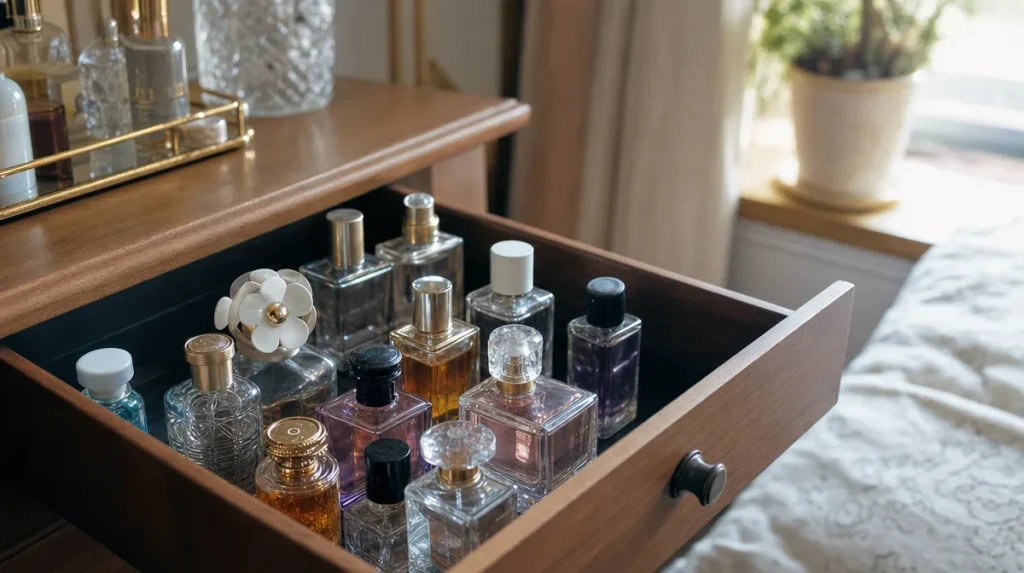
- Storage matters as much as application: a bottle kept on a steamy bathroom shelf can lose character within months, while one kept cool and dark in a drawer can perform well for years.
Why The Tester Never Smells Like Your Skin
Fragrance is not a fixed thing. It is a chemical mixture reacting with whatever it lands on, and your skin is not the same surface as the paper strip in the shop or your friend’s arm.
Skin pH, natural oil production and even diet all shift how a scent reads. This is why two people can wear the same eau de parfum and one smells warm and sweet while the other smells sharp and green within the hour.
Think of a fragrance the way a chef thinks of a marinade. The same marinade tastes different depending on what it is soaking into: a firm chicken breast, a fatty piece of pork, a delicate fish fillet. The liquid has not changed. The surface has.
A 2017 review in Flavour and Fragrance Journal noted that skin surface lipids can alter the perceived balance of top, heart and base notes measurably within the first thirty minutes of wear. That early shift is normal, not a sign that something is wrong with the product.
The practical takeaway is simple: do not judge a fragrance by how it smells straight from the bottle, or even in the first ten minutes on skin. Give it time to settle before deciding whether it works for you, and stop comparing your own skin’s result to how it smelled on someone else.
Prepping Skin So The Scent Has Something To Hold Onto
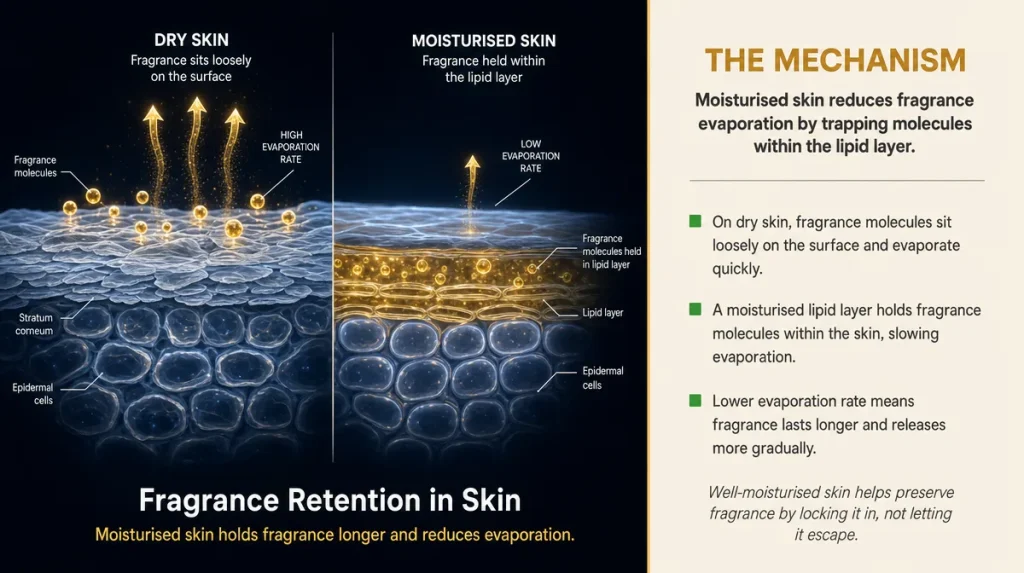
Fragrance molecules need a surface to cling to. Dry skin is a poor one: fewer lipids, faster evaporation, and the eau de parfum simply lifts off into the air within an hour or two.
Applying a fragrance-free moisturiser to pulse points before spraying gives those molecules something to bind with, much the way a damp sponge holds soap suds longer than a dry one. The moisturiser itself does not need to smell of anything. Its job is purely to condition the surface.
A small trial reported at an IFSCC congress paper compared fragrance longevity on moisturised versus unmoisturised forearm skin and found a visibly longer detectable presence on the hydrated side after six hours, though results varied between the individuals tested.
The mistake most people make is spraying fragrance onto skin straight out of the shower without any barrier product at all, assuming clean skin is ready skin. Clean is not the same as primed. If your skin runs dry generally, this single step, done consistently, will likely do more for how long your perfume lasts than switching to a different bottle ever would.
Self-test: spray on bare skin one day and on lightly moisturised skin the next, at the same time of day, and compare how the scent reads by early evening.
Where To Spray, And Why Pulse Points Earn The Name
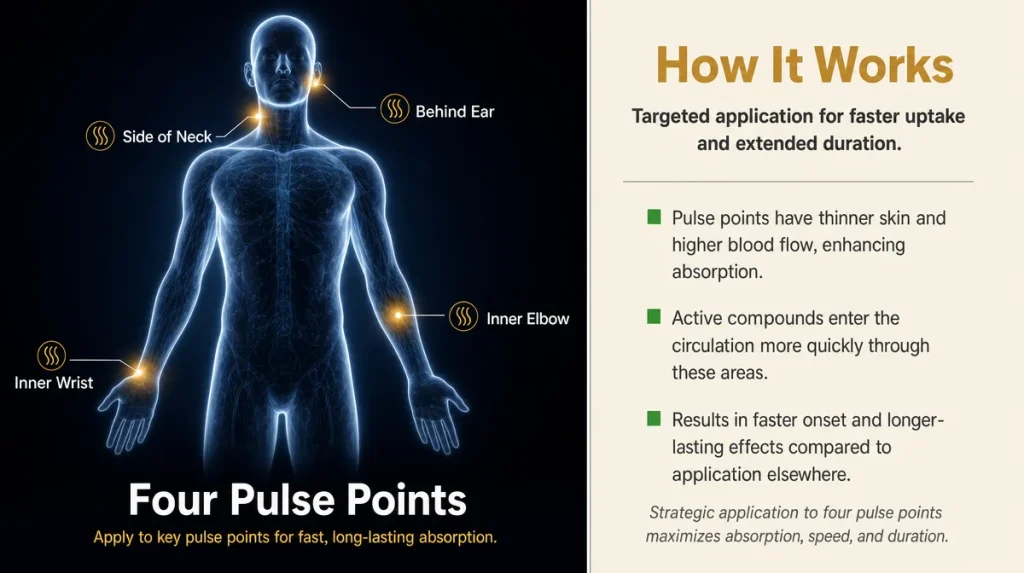
Pulse points, the inner wrist, the side of the neck, behind the ear, the inner elbow, are warmer than most of the rest of the body because blood vessels sit close to the surface there.
Warmth helps fragrance evaporate at a steady, gradual rate rather than all at once, which is what allows a scent to move through its top, heart and base notes over several hours instead of blasting out and fading fast.
A useful analogy: think of a kettle left on a low simmer versus one brought to a hard boil. The low simmer releases steam steadily over a long stretch. The hard boil is dramatic and brief. Pulse points are the simmer.
Spray from roughly ten to fifteen centimetres away from the skin, not directly against it. Spraying too close concentrates the liquid unevenly and can make the alcohol in the formula more noticeable than the fragrance itself.
Many people spray only the wrists and stop there. Adding the collarbone area and the nape of the neck, where scent tends to rise gently as the day goes on, gives a more rounded impression to anyone standing close, without needing more product overall.
The Wrist-rub Habit That Undoes The First Ten Minutes
Almost everyone does this: spray both wrists, then rub them together. It feels tidy. It is one of the most common ways to shorten a fragrance’s life.
Friction generates a small amount of heat and physically disrupts the top notes, the lightest, most volatile molecules in the formula, causing them to evaporate faster and sometimes to smell slightly sour or off as they break down under pressure rather than air.
The better habit is to spray and let the liquid dry undisturbed, or at most dab lightly with the back of the wrist against the other wrist rather than rubbing.
If you want scent on both wrists, spray each one separately rather than spraying one and transferring it by rubbing. It takes an extra second and it changes how the fragrance opens.
This is a small, mechanical fix rather than anything to do with the formula, and it is free. It is also one of the easiest habits to unlearn, precisely because it feels instinctive to smooth in a fragrance the way you might smooth in a hand cream.
Layering Without Buying Anything New
Layering usually gets pitched as needing a matching body lotion or shower gel from the same range. It does not require either.
Any fragrance-free or very lightly scented body lotion applied before your eau de parfum acts as a base coat, similar to how a primer helps paint hold to a wall rather than soaking straight into bare plaster.
The fragrance sits on top of that layer instead of directly on dry skin, and the combination can noticeably extend how long the scent is detectable without changing its character, because the base layer is neutral.
What does not work well is combining two strongly scented products, a heavily perfumed shower gel and a distinct eau de parfum, since the two will compete and can muddy each other rather than build a coherent scent.
If you own several fragrances, resist the instinct to mix two of them on the same day hoping for a new hybrid. Fragrances are formulated as complete structures. Layering two finished perfumes on top of each other usually flattens both rather than improving either.
Storage: The Bathroom Shelf Is Quietly Ruining Your Bottle
Perfume is a mixture of alcohol, water, aromatic compounds and sometimes colourants, and all of that is sensitive to heat, light and temperature swings.
A bathroom shelf, warmed by showers and lit by a window or a bright bulb, is close to the worst place to keep a bottle long term. Over months, heat and light can break down the aromatic compounds, shifting a fragrance’s balance so the top notes fade early and what remains smells flatter or more alcoholic than it once did.
Think of it the way you would think of a bottle of good olive oil left beside a stove. Nothing looks different on the outside. The contents are quietly degrading anyway.
A cool, dark drawer or a dedicated box away from direct sunlight and radiators will keep a bottle performing closer to how it did on the day you opened it, for considerably longer.
If you notice a fragrance you once loved now smells noticeably different or weaker than you remember, check where it has been living before assuming the formula itself has changed.
Reading How A Scent Moves Through The Day
A well-made eau de parfum is not one smell held at a constant level. It is built in stages: top notes that greet you in the first fifteen to thirty minutes, heart notes that emerge over the next hour or two, and base notes that carry the fragrance through the afternoon and into the evening.
Judging a fragrance only by that first spray is a bit like judging a whole meal by the smell of it walking past the kitchen. The dish has not been plated yet.
If you want to genuinely evaluate whether a fragrance suits you, wear it for a full day rather than testing it for five minutes in a shop or against a strip. Note how it smells at the two-hour mark and again toward evening. Many fragrances that feel underwhelming on first spray develop into something warmer and more distinctive once the base notes settle in.
This also explains why a fragrance can smell markedly different indoors under heating than it does outdoors in cooler, drier air. Warmth accelerates the whole progression, so a scent may move through its stages faster on a heated indoor day than on a cool one.
Resetting Your Nose When Everything Starts To Smell The Same
After wearing the same fragrance for a stretch of time, or after spending ten minutes smelling several perfumes in a row, your sense of smell genuinely fatigues. This is called olfactory adaptation, and it is well documented in sensory science: receptors exposed to a consistent odour stop signalling it as strongly to the brain.
It is the reason you stop noticing your own fragrance by mid-morning even though someone sitting beside you can smell it clearly. Your nose has not failed. It has adjusted.
A quick reset, commonly used by fragrance counter staff, is to smell the inside of your own elbow or a piece of clean fabric, or simply to step outside for fresh air for a minute, before evaluating a scent again.
This matters for a practical reason: if you cannot smell your own perfume by early afternoon, resist the urge to reapply generously, since others around you may still be smelling it clearly at full strength. A light touch-up on one pulse point is usually enough, rather than a full second application.
Key Takeaways
Getting more out of a fragrance you already own comes down to a handful of habits rather than any new purchase. Moisturised skin holds scent longer than dry skin. Pulse points work because they are warm, not because tradition says so. Rubbing wrists together damages the top notes within minutes. Storage away from heat and light preserves a formula for years rather than months. And judging a fragrance properly means giving it hours, not seconds, and giving your own nose a rest before deciding it has faded.
A Quick Practical Checklist
- Moisturise pulse points with a fragrance-free lotion before spraying, especially if your skin runs dry
- Spray from about ten to fifteen centimetres away, not pressed against the skin
- Let the fragrance dry undisturbed; avoid rubbing wrists together
- Add the collarbone and nape of the neck to your usual wrist application
- Store bottles in a cool, dark drawer, away from bathroom steam and direct sunlight
- Judge a fragrance across a full day, checking in at the two-hour mark and again in the evening
- If you can no longer smell your own perfume, touch up lightly rather than reapplying heavily
This article is for general information only and does not replace individual advice from a dermatologist or pharmacist.
Individual results vary depending on skin type, formula and environmental conditions.