
Nathan Pryce, Staff Writer.
You are standing in front of the bathroom mirror on the third morning, can in hand, and the roots still look flat and faintly grey where the powder has sat too long. You already own two, maybe three, dry shampoos: a travel-size aerosol from a hotel gift shop, a tinted powder someone recommended, a foam that promised something different and delivered much the same. The question you type into a search bar late at night is not which one to buy next. It is why doesn’t dry shampoo work as well as it used to.
The honest answer rarely has anything to do with the product on the shelf. Dry shampoo does not clean hair the way water and surfactant do. It works by adsorption: fine starch or clay particles sit on the hair and scalp and bind to the oil already there, the way blotting paper lifts grease from skin without washing it away. Get the particle placement and timing wrong, and even a well-formulated spray will sit on top of the oil rather than lifting it. Get the technique right, and the can already open in your bathroom cabinet will do more than it has been doing for months.
- Give it time before you touch it: dry shampoo needs a few minutes of contact time to absorb oil before brushing or styling, not the ten seconds most people allow.
- Aim at the scalp, not the hair: sectioning the roots and spraying close to the parting does more than covering the whole head with product.
- The brush finishes the job: distributing and removing residue with the right bristle type matters as much as the formula itself.
The Three-day Question
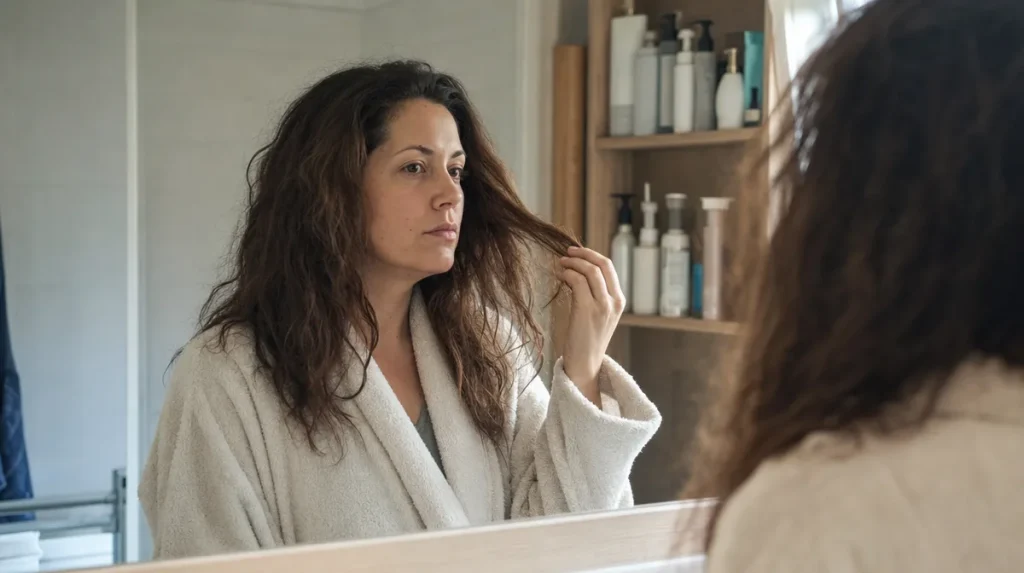
Ask around and most people say the same thing: the dry shampoo that worked brilliantly in the first week seems to lose its power by the third or fourth use. The instinct is to blame the formula and go looking for a stronger one, a pricier one, one with a different scent.
A 2021 consumer survey conducted for a UK haircare trade body found that most users apply dry shampoo within seconds of spraying it, without waiting for it to take effect, and reapply more heavily when the first pass looks patchy. That pattern, more than the product itself, is usually behind the disappointment.
Dry shampoo is a tool with a technique attached, in the same way a kettle needs the right amount of water to boil quickly. Buying a new one rarely fixes a habit problem. Understanding what the product is actually doing on the scalp, and adjusting how it is applied, tends to solve it faster and for free.
What Dry Shampoo Is Actually Doing To Your Scalp
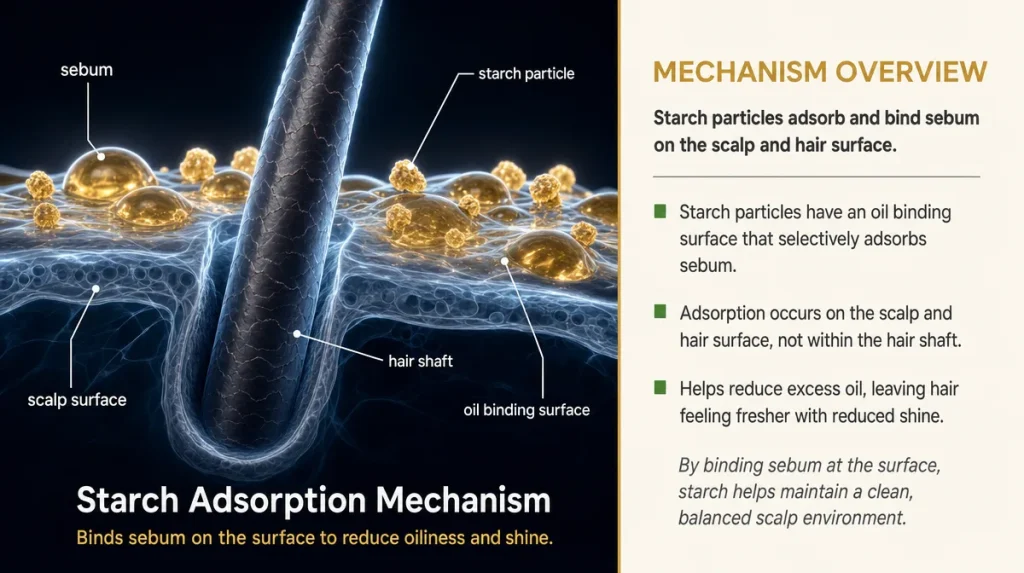
Dry shampoo relies on adsorption rather than absorption, a distinction with practical consequences. Absorption means a substance is drawn into something, the way a sponge takes up water. Adsorption means particles bind to a surface, the way flour dusted on a greasy worktop picks up the grease sitting on top of it without soaking into the wood.
The active ingredients in most formulas, typically rice starch, tapioca starch or kaolin clay, work the second way. They sit on the hair shaft and scalp, and their particle surface has an affinity for sebum, the natural oil the scalp produces. A congress paper presented to the International Federation of Societies of Cosmetic Chemists described how particle size and surface area directly affect how much oil a given starch can bind before it becomes visibly saturated, at which point it stops disguising oil and starts sitting on top of it as a dull film.
This matters for technique because saturation is the enemy. A thin, even layer of particles has surface area available to bind oil. A thick layer applied all at once, in the hope of buying an extra day before washing, saturates faster and looks worse sooner. Less product, applied with intent, generally outperforms more product applied in a hurry.
The Three Minutes Nobody Waits For
Spray, brush, done: that is how most people use dry shampoo, and it is the single biggest reason results disappoint. Starch and clay particles need a short window of contact time to bind the oil sitting on the scalp. Brush or style immediately and the particles have not had the chance to do their work; they simply get pushed around, sometimes deeper into strands that were already clean.
The practical fix takes patience rather than money. Hold the can roughly 15 to 20 centimetres from the scalp, a distance most labels state but few people measure. Spray in short bursts along the parting rather than one long pass, then leave it alone for three to five minutes. Do something else: brush your teeth, choose an outfit, read the next section of this article.
Only then work it through. Brushing too soon is the most common cause of the pale, ashy cast that makes people assume a product does not suit their hair colour, when the real issue is timing rather than shade match. Waiting also reduces how much product is needed overall, since particles that have finished adsorbing oil brush out more completely than ones still sitting wet with sebum underneath.
Finding The Roots Without A Mirror Trick
Oil accumulates fastest at the crown and around the hairline, not evenly across the head, so blanket spraying wastes product on lengths that were never the problem. Sectioning solves this without needing a second person or a salon mirror setup.
Part hair into two to three centimetre sections, starting at the crown and working outward, lifting each section to expose the scalp directly. Spray at the root of each exposed section rather than the surface of the hair sitting over it. This is slower than one sweeping pass over the whole head, but it uses less product for a better result, since the particles land where the oil actually is.
A quick self-test helps calibrate this for your own scalp. Run a clean finger along your natural parting at the end of the day and check what transfers: visible shine or residue there marks your priority zone for next time. Most people find the crown and the two centimetres either side of the parting need attention every time, while the sides and nape need it far less often. Treating the whole scalp identically, when oil production is not identical across it, is one of the quieter reasons a product gets blamed for uneven performance.
Brushing Out The Cast, Not Just The Powder
The brush matters almost as much as the spray. A natural bristle brush, boar bristle being the most common, does two things a plastic paddle brush does not: it distributes the remaining oil down the hair shaft rather than leaving it concentrated at the root, and its finer bristles work through fine particle residue more thoroughly.
Brush in sections, starting close to the scalp and working down, rather than one long stroke from crown to ends. For extra volume at the crown, flip the head forward and brush from the nape upward before flipping back; this lifts roots that flatten under the weight of styling products and evens out any residual cast at the same time.
A study published in a peer-reviewed cosmetic science journal in 2023 compared residue visibility on dark versus light hair after dry shampoo application and found that thorough brushing, rather than product choice, was the strongest predictor of whether residue remained visible after five minutes. That held across shade depths, though deeper shades made any remaining residue more noticeable to the eye, which is one reason people with darker hair often reach for tinted formulas rather than assuming a different technique might solve the same problem for less.
Powder, Aerosol Or Foam: What Changes And What Doesn’t
The delivery format changes how a product feels going on, not what it is fundamentally doing once it lands. Aerosols disperse particles more finely and evenly, which tends to reduce visible cast on fine or lighter-coloured hair, since less product sits in any one spot. Loose powders allow more precise targeting for a single oily patch, at the cost of a fussier application. Foams and mousses sit between the two, offering more visible control over where product goes, but they still need the same few minutes of contact time before brushing.
None of these formats changes the underlying chemistry: starch or clay adsorbing sebum. Marketing language, on the other hand, changes a great deal, and shoppers browsing beauty halls or online retailers will find claims about invisible formulas, added fragrance systems, or scalp-care extras layered onto the same basic mechanism. The Good Housekeeping Institute has previously noted, in its general product-testing commentary, that clarity of use-instructions on packaging varies far more between brands than the core performance of the active ingredient itself. Reading the instructions, in other words, is often worth more than reading the claims above them.
Why The Same Product Looks Different On Day Two Versus Day Five
Sebum production is not constant through the week. It responds to factors including humidity, indoor heating, exercise, and how recently hair was last washed with water, which is why the same can that performed well on day two can look patchy by day five. Layering dry shampoo repeatedly without an actual wash also means particles from earlier applications remain on the scalp, mixing with fresh oil rather than binding a clean surface each time.
This build-up, not a change in the product, is usually why results seem to decline over consecutive uses. The fix is less about product rotation and more about resetting the scalp periodically with a proper wash, even a quick one, rather than extending the gap indefinitely. Public guidance from the American Academy of Dermatology on general scalp care notes that washing frequency should reflect individual oil production and activity levels rather than a fixed schedule, which is a useful reminder that there is no universal number of days a scalp should tolerate between washes. For most people, alternating a lighter clarifying wash with dry shampoo days, rather than stacking dry shampoo for as long as possible, keeps both the scalp and the results looking better.
Troubleshooting The White Cast And Other Common Complaints
Most dry shampoo complaints trace back to one of three causes: rushing the contact time, applying too much in one spot, or a mismatch between particle colour and hair depth. All three are fixable without buying anything new.
For the white or grey cast that shows up along the parting, the self-test is simple: rub a small amount of product between clean fingers first and check the colour it leaves against your own hair, in daylight rather than bathroom lighting, before applying it to the scalp. If it reads visibly lighter than your hair, apply less at the roots and brush more thoroughly, or reserve it for areas naturally lighter, such as sun-lightened ends.
Applying dry shampoo to hair that is already visibly oily, rather than at the first sign of oil, is another common misstep: the particles have less spare capacity to bind additional sebum once the scalp is already saturated, so earlier, lighter application generally outperforms a heavier rescue attempt later in the day. If cast or flaking persists even after adjusting timing, section size and amount, it may be worth checking whether the scalp is reacting to a specific ingredient rather than to the technique, a question a pharmacist can usually help narrow down quickly and without needing a referral.
Key Takeaways
- Dry shampoo adsorbs oil, it does not clean it away, so a thin, well-placed layer beats a heavy one.
- Wait three to five minutes after spraying before brushing or styling.
- Section the hair and spray at the scalp, prioritising the crown and parting rather than the whole head.
- Brush thoroughly with a natural-bristle brush to distribute oil and remove residue.
- Reset the scalp with an occasional proper wash rather than stacking dry shampoo indefinitely.
A Quick Checklist Before You Spray
- Shake the can and hold it 15 to 20cm from the scalp.
- Section hair in two to three centimetre partings, starting at the crown.
- Spray in short bursts directly at the root, not along the lengths.
- Wait at least three minutes before touching it.
- Brush from roots to ends in sections, then flip and brush the crown upward for volume.
- Rub a small amount on clean fingers to check colour match before applying near the front hairline.
- Plan a proper wash within a few days rather than extending indefinitely.
This article is general information and does not replace personalised advice from a dermatologist or pharmacist.
Individual results vary with hair type, scalp condition and product formulation.