
Emma Whitfield, Beauty Editor.
There is a particular moment, somewhere around midday, when a reader catches her reflection in a lift mirror or a car window and sees the makeup she carefully built that morning has gone patchy along the nose, vanished from the eyelids, and pooled faintly under the eyes. The bathroom shelf usually tells the story: three or four half-used bottles of setting spray, each bought after the last one “stopped working”, none of them actually faulty. The truth is less about the bottle and more about how it was used. A setting spray is, chemically, a thin film sitting on top of makeup, and like any film it depends on a clean, dry, evenly prepared surface to bond properly. Get that part right and even a modest formula will outperform an expensive one applied badly. This guide walks through what is actually happening on the skin, the method that gives a film the best chance of holding, and the marketing language worth ignoring.
- Distance and drying time matter more than price: a spray held 20 to 25 centimetres away in light passes, with 30 seconds to dry between them, outlasts a single close-range soaking almost every time.
- Oil, not time, is usually what breaks a film down: sebum and heavy moisturiser dissolve the polymer mesh from underneath, which is why oily zones need extra preparation, not extra spray.
- “24-hour wear” is a lab claim, not a promise: it is typically measured on a static panel in controlled conditions, so humid heat, sweat, and touching the face will always shorten it in real life.
Why Setting Spray Disappears By Mid-afternoon

Most setting sprays work on the same basic principle: a small amount of film-forming polymer dissolved in a fast-evaporating carrier, usually water or a light alcohol blend. Once sprayed, the carrier evaporates and leaves behind a very thin, flexible mesh sitting over the makeup underneath it, holding pigment particles in place the way a coat of varnish holds wood fibres together against weather.
The problem is what that varnish is bonding to. Skin produces sebum continuously, and sebum is an oil. Oils are excellent solvents for many of the polymers used in setting sprays, which means that on an oily T-zone the film can start breaking down within hours, not because the product is poor but because the surface underneath keeps generating a solvent that eats away at it.
Humidity adds a second problem. A 2022 paper presented at an IFSCC congress on film-forming cosmetic polymers noted that ambient moisture can soften certain film formers, making them tackier and more prone to smudging rather than more resistant, which is the opposite of what most people assume about humidity and long wear.
Dry, heated indoor air causes a different failure: the film can become brittle and flake rather than dissolve, particularly around the nose and mouth where the skin moves the most. Neither failure means the spray was wrong. It usually means the skin’s condition on that particular day was not accounted for before spraying.
What Is Actually Happening When You Spray It On
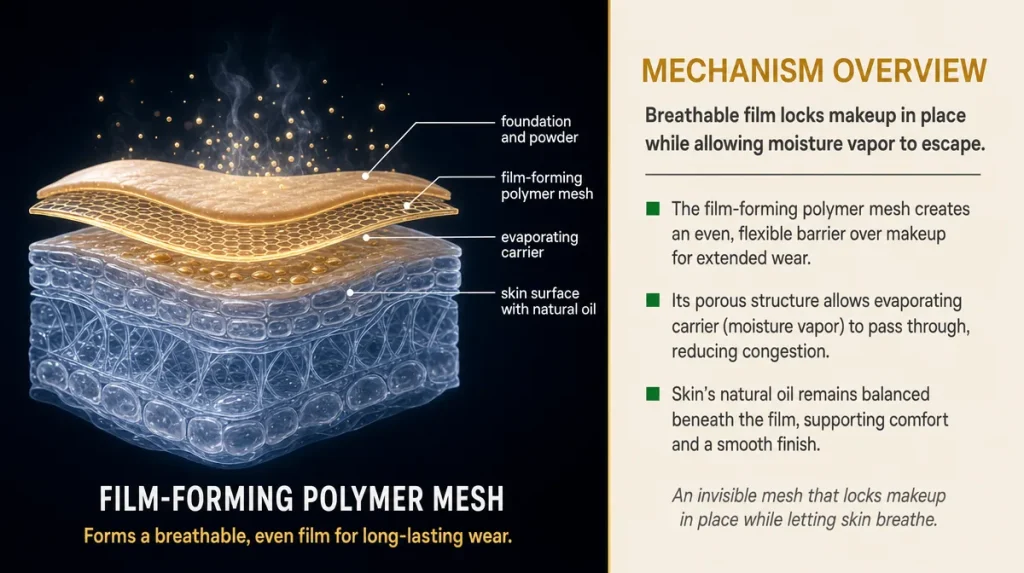
It helps to picture the process in two stages rather than one. The first stage is wet: fine droplets land across the face, the carrier still liquid, sitting on top of foundation and powder. The second stage, which most people rush, is the drying stage, when the carrier evaporates and the polymer molecules link together into that thin mesh.
If a second layer of makeup, a hand, or a piece of clothing touches the face before that second stage finishes, the half-formed mesh smears rather than sets, taking pigment with it. This is why a spray that seems to work beautifully in the bathroom can look patchy an hour later: the film never finished curing before something disturbed it.
A useful comparison is nail polish. Nobody expects to close a book on wet nail polish and get a clean result. The same patience applies here, just on a much smaller time scale, usually 20 to 40 seconds depending on the formula and the room’s humidity.
Matching The Formula To How Your Skin Actually Behaves
Skin type matters here more than shade range or finish photographs online. Oily and combination skin generally does better with a mattifying, oil-absorbing formula, often built around silica or clay-derived ingredients that soak up surface sebum rather than simply sitting on top of it. Without that absorption step, even a strong film former is fighting a losing battle against the skin’s own oil production within a few hours.
Dry or mature skin tends to do better with a hydrating, mist-style spray containing humectants such as glycerin, which prevent the film from looking cakey or emphasising fine lines as the skin’s own moisture drops through the day. A dermatologist-tested, fragrance-free formulation is generally the safer starting point for sensitive or reactive skin, since fragrance and certain preservative systems are among the more common triggers for irritation in facial mists, according to general guidance published by the American Academy of Dermatology on cosmetic sensitivity.
Combination skin, the most common category, often benefits from treating the face as two zones rather than one: a light pass of a mattifying formula across the centre panel, and a hydrating pass at the cheeks and jawline, rather than a single all-over blast of one product.
The Application Distance And Pattern That Changes Everything
The single biggest technical fix is distance. Held too close, the spray delivers large droplets that pool and can disturb foundation underneath, especially around the eyes and nose where the skin is thinner. Held at roughly 20 to 25 centimetres, most nozzles atomise the liquid into a fine, even mist that lands lightly rather than pooling.
A cross or figure-of-eight motion, moving the hand steadily rather than pausing over any one area, spreads the mist more evenly than spraying straight at the face and holding still. Two to three light passes, each allowed to dry for around 30 seconds before the next, generally outperform one heavy application, because each thin layer cures fully rather than sitting wet under the next.
Eyes should stay closed and the mouth relaxed rather than pursed, since tension around the mouth creates fine creases that the spray settles into, exaggerating lines that were barely visible before. Letting the face air-dry for a full minute before touching it, applying sunglasses, or pulling on a jumper gives the film its best chance of setting properly rather than transferring onto fabric.
The Mistakes That Quietly Undo A Good Setting Spray
The most common mistake is spraying immediately after a heavy moisturiser or a rich primer has been applied, before it has had time to absorb. The setting spray’s film then sits on a slick, oily surface rather than a settled base, and slides rather than bonds. Waiting a genuine two to three minutes after moisturiser, and confirming the skin looks matte rather than shiny before applying base makeup, solves this in most cases.
A second frequent error is skipping powder on oily zones because the spray is expected to do that job instead. Setting spray is not designed to absorb oil in the way a translucent powder is: it locks a look in place, it does not control sebum production. Skipping powder on the T-zone and relying on spray alone tends to produce a shinier, faster-fading result by midday.
A third mistake is treating the spray as a touch-up tool. Reapplying spray over makeup that has already broken down, without blotting or gently reapplying powder first, tends to reactivate the old film and smear it further rather than refresh it. A blotting paper or a light dusting of powder before any midday reapplication generally gives a cleaner result than spray alone.
Where Setting Spray Fits In The Rest Of The Routine
Order matters as much as product choice. A typical sequence runs: cleansed and moisturised skin, sun protection where relevant, primer once the moisturiser has absorbed, then foundation and concealer, then powder on the areas that need it, and setting spray last, as the final step rather than an early one.
Applying setting spray before powder, in the hope that it will help the powder stick, generally backfires, since the powder then sits on a damp surface and can go patchy as it dries unevenly. The spray’s job is to seal a finished look, not to prepare the skin for the next layer.
SPF also deserves a mention here. If sun protection is built into a separate step rather than the foundation, it should go on clean, dry skin before makeup begins, not sprayed on afterwards as a mist, since spray sunscreens are formulated and tested to be applied generously and directly to skin, a different use case from setting a finished face of makeup.
Judging Whether It Actually Held Up, And When To Step In
A simple, honest self-test: around the middle of the day, press a clean tissue gently to the T-zone for a few seconds without rubbing. A faint mark is normal. A tissue that comes away visibly oily and pigmented suggests the film has broken down in that zone and a light touch-up, not a full reapplication, is the more useful move.
Realistic expectations help too. A film that holds cleanly through several hours of normal indoor activity, including talking and moderate movement, is doing its job well. Visible fading around the nose, chin, or under the eyes by the afternoon in humid heat or after physical activity is common and does not indicate a faulty product, since these are the areas with the highest oil output and the most repeated movement.
If a formula consistently fails within an hour regardless of technique, in a climate-controlled indoor setting, it may genuinely be a poor match for that skin’s oil level rather than a technique problem, and it may be worth trying a formula from the other category, mattifying instead of hydrating or vice versa.
Marketing Language Versus What The Physics On A Face Allow
Terms such as “24-hour wear” or “waterproof” are usually measured under controlled panel conditions: a set room temperature, limited touching of the face, and often a specific test population. General testing commentary from bodies such as the Good Housekeeping Institute has long noted that identical cosmetic formulas can perform very differently once humidity, sweat, and repeated touching are introduced, which is closer to how most days actually unfold.
A 2023 study in the Journal of Cosmetic Science examining film-forming setting products found that wear time under simulated humid conditions dropped by a meaningful margin compared with the same formulas tested in dry, climate-controlled conditions, reinforcing that a single wear-time figure printed on a bottle rarely reflects every climate a reader might be in.
Beauty glossies such as Vogue and Allure have written for years about setting spray as the finishing step of a routine, and that framing is broadly accurate: it is a finishing touch, not a substitute for skin preparation, oil control, or a base makeup applied in thin, well-blended layers. No mist, however well marketed, can compensate for a foundation applied too thickly or skin that was not properly prepped beforehand.
Key Takeaways
A setting spray’s staying power depends far more on preparation and technique than on price or brand claims. Oil from the skin, not time itself, is usually what breaks the film down, which is why matching the formula to skin type and controlling oil separately with powder makes the biggest practical difference. Distance, light layering, and patience while the film dries matter more than how much product goes on. Wear-time claims are measured in controlled conditions and will always shorten in humid heat, after sweating, or with frequent touching, so treating a printed number as a rough guide rather than a guarantee avoids disappointment.
A Quick Pre-application Checklist
- Let moisturiser and primer absorb fully before applying makeup, checking that skin looks matte rather than shiny
- Choose a mattifying formula for oily or combination zones, a hydrating mist for dry areas
- Hold the bottle 20 to 25 centimetres from the face and use light, even passes
- Allow 30 seconds between passes and a full minute before touching the face, applying sunglasses, or dressing
- Powder oily zones separately rather than relying on the spray to control shine
- Blot with tissue before any midday touch-up rather than spraying over an already broken-down film
- Judge results by how skin behaves in that day’s actual conditions, not by the number printed on the bottle
This article is general information and is not a substitute for personalised advice from a dermatologist or pharmacist.
Individual skin behaviour and results vary, particularly with climate, oil production, and how a product is applied.