
Graham Beattie, Senior Health and Science Editor.
She is standing at the bathroom mirror with four palettes fanned out on the shelf, and none of them is quite right for the ten minutes she has before the school run or the commute. One is too shimmery for a Tuesday. One creased by lunchtime last time she wore it. One she bought on a whim and has used twice. The question she actually types into her phone later that day is not “best eyeshadow palette” but something closer to “why does my eyeshadow disappear by midday.”
The honest answer has less to do with the palette itself and more to do with what happens underneath it, on the eyelid, in the first ninety seconds of application. A 2021 study in the International Journal of Cosmetic Science found that eyelid skin sheds natural oils at a noticeably faster rate than the rest of the face, which is precisely why colour that looks perfect at 8am can look muddy by 1pm. Understanding that one mechanism changes almost everything about how a routine should be built. This guide walks through the steps that make eyeshadow behave, from base to blend to the mistakes that undo good work in seconds, without telling you what to buy.
- Prime the lid, not just the face: eyelid skin releases oil faster than the rest of the face, so a thin, purpose-built base extends wear more reliably than pressing harder with colour.
- Build in three light layers, not one heavy one: thin passes of colour bind to the lid and to each other, while one thick application tends to sit on top and crease.
- Blend at the edges, not the centre: most of what reads as a mistake in photos is really an unblended boundary, and softening just the outer edge fixes the majority of that.
Why Eyeshadow Moves When Nothing Else On Your Face Does
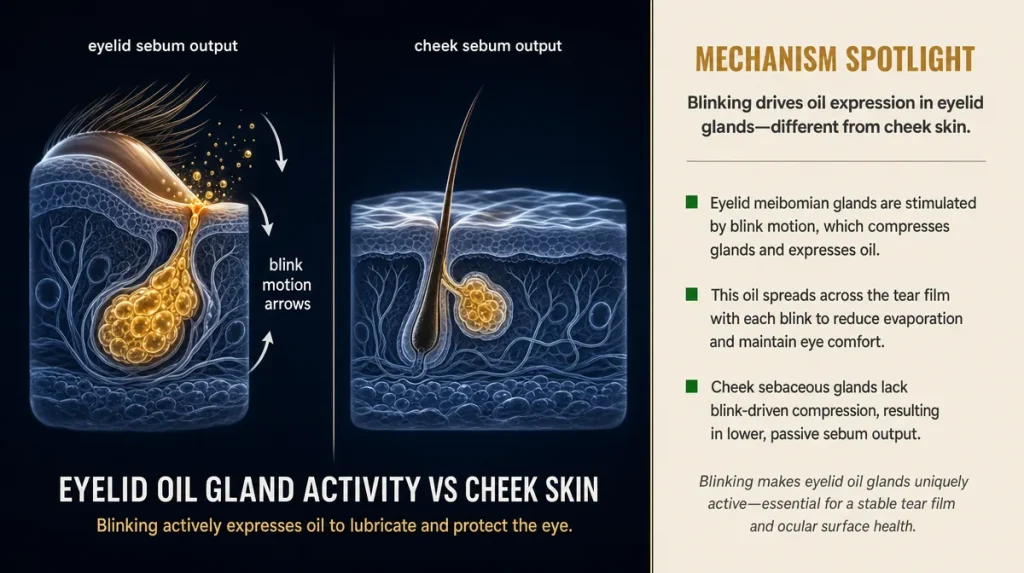
The eyelid is thin, mobile and constantly folding as you blink, which happens roughly fifteen to twenty times a minute. Think of it as the one part of the face that behaves like a hinge rather than a wall: a wall holds paint well, a hinge flexes it off.
A 2021 study in the International Journal of Cosmetic Science measured sebum output across different facial zones and found the eyelid produces oil at a visibly higher rate relative to its surface area than the cheeks or forehead. That oil is what allows pigment to slide into the crease of the lid rather than staying where it was placed.
This is why a palette that performs beautifully on a wrist swatch can still crease on a lid within a few hours. The product has not changed. The surface it is sitting on has.
Finding Your Undertone In Daylight
Most colour disappointment traces back to undertone, not shade depth. A soft brown that reads warm and flattering in a shop’s fluorescent light can look ashy or heavy once you step outside.
The simplest self-test takes thirty seconds. Stand near a window with natural light, hold a piece of white paper under your jaw, and look at the inner side of your wrist. Greenish veins tend to suggest a warmer undertone, bluish veins a cooler one, and a mix of both is common and entirely normal.
Once undertone is roughly known, shade depth becomes the easier decision. Describing depth in words rather than by brand-specific naming systems helps here: a fair-to-light lid generally carries mid-tone shades without them reading heavy, while a deep lid can wear the same mid-tone shade almost translucently and needs richer pigment to show at all. Neither is a flaw in the skin. It is simply how pigment sits on more or less melanin.
The Base Layer Nobody Talks About
Reach for colour and most people skip the step that determines whether it lasts: a thin, oil-absorbing base across the lid before any pigment goes on. This is not the same as face moisturiser and it is not the same as concealer, both of which tend to sit too heavily on eyelid skin and can, ironically, speed up creasing.
Applied correctly, this base is closer to a very light veil, almost imperceptible, that gives pigment something matte and dry to grip onto rather than warm, mobile skin. Dermatologists writing in general skin-health guidance from the American Academy of Dermatology have long noted that oil control at the point of application, rather than heavier product overall, is what most reliably extends wear time for any eye makeup.
The common mistake is applying this base with a finger, which transfers hand oil right back onto the lid. A small flat brush or a clean sponge tip does the job more cleanly.
Layering Colour So It Actually Stays
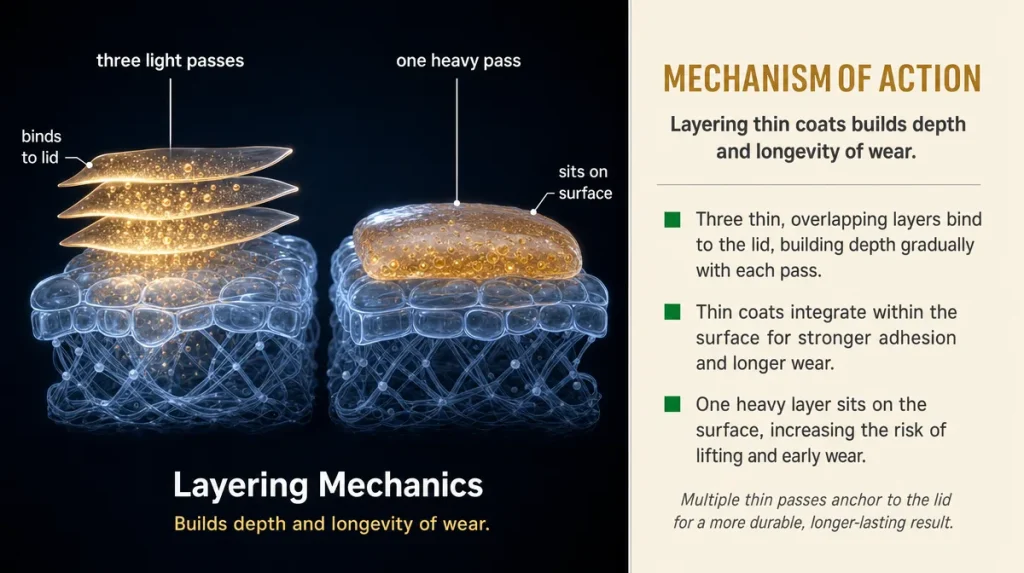
One heavy swipe of shadow looks fine in the mirror and often looks patchy or dull within the hour. Pigment particles need several thin passes to bind to each other and to the lid, much the way a wall takes an even coat of paint better after two light layers than one thick one.
The practical method: apply the lightest transition shade first across the crease with a fluffy brush, using small circular motions rather than dragging. Then apply the main lid colour in the centre of the eyelid only, pressing the brush down rather than sweeping it, which packs pigment rather than pushing it around. Build a third, deeper shade only at the outer corner if more definition is wanted.
Each layer should be visibly sheer on its own. It is the stacking that creates depth, not the thickness of any single pass. This also means colour lasts longer, because thin bound layers resist smudging better than one saturated layer sitting loosely on the surface.
Where Cheap And Careless Application Actually Shows
Two things separate a look that holds up from one that does not, and neither is about spending more.
The first is blending at the boundary. A visible hard edge, particularly where the lid colour meets the crease shade, is the single most common giveaway of a rushed application, far more than the shade choice itself. Softening only that edge, using a clean fluffy brush with no product on it, fixes the majority of what reads as a mistake in photographs.
The second is skipping a base entirely on the theory that a palette is pigmented enough to compensate. It rarely is, over a full day. A 2019 consumer survey referenced by Allure found that creasing was the single most cited eyeshadow complaint among respondents who wore makeup for eight hours or more, ahead of colour fading or fallout.
Neither of these fixes requires new products. They require a different order of steps.
What Realistic Wear Time Looks Like
A well-prepped lid with thin, layered colour and a light setting pass can reasonably be expected to hold its shape for six to eight hours of normal indoor conditions, according to wear-testing methodology described in general guidance from Consumer Reports on cosmetic longevity claims. In humid heat or in rooms with strong indoor heating, that window narrows, sometimes to four or five hours, simply because both oil production and product movement increase.
A small amount of settling into the crease line by the afternoon is normal and not a sign of doing anything wrong. What is worth troubleshooting is colour that has visibly migrated onto the brow bone or gathered in a hard line by midday, which usually points back to skipped base or too much product pressed on at once.
Judging results fairly means checking at the three-hour mark, not the first ten minutes. Most creasing that will happen has already started by then, and it is the easiest point to learn what your own skin does.
Sorting Marketing Language From What Actually Matters
Palette packaging carries a great deal of language that sounds technical without changing how the product behaves on skin. Terms like “velvet finish” or “24-hour formula” describe intent, not a guaranteed outcome, and wear time depends far more on the preparation steps above than on any single formulation claim printed on a box.
What does matter, and is worth checking before buying anything, is whether a palette is described as fragrance-free and dermatologist-tested, plain wording that reflects a genuine testing step rather than a marketing flourish. The IFSCC’s published congress research on eye-area formulation has repeatedly noted that pigment particle size and binder quality affect both blendability and irritation potential far more than finish descriptions do.
A useful rule: read the ingredient list position of binding agents (often listed as dimethicone or similar silicones near the top) rather than the front-of-pack adjectives. That single detail says more about how a shadow will actually wear than most of the language surrounding it.
Removing It Without Undoing Your Skin Barrier
How eyeshadow comes off matters almost as much as how it goes on. Vigorous rubbing to remove stubborn pigment, particularly around the eye where skin is thinnest on the whole face, can visibly aggravate the area over time and may contribute to premature fine lines, a point general AAD skincare guidance has made repeatedly in the context of eye-area care.
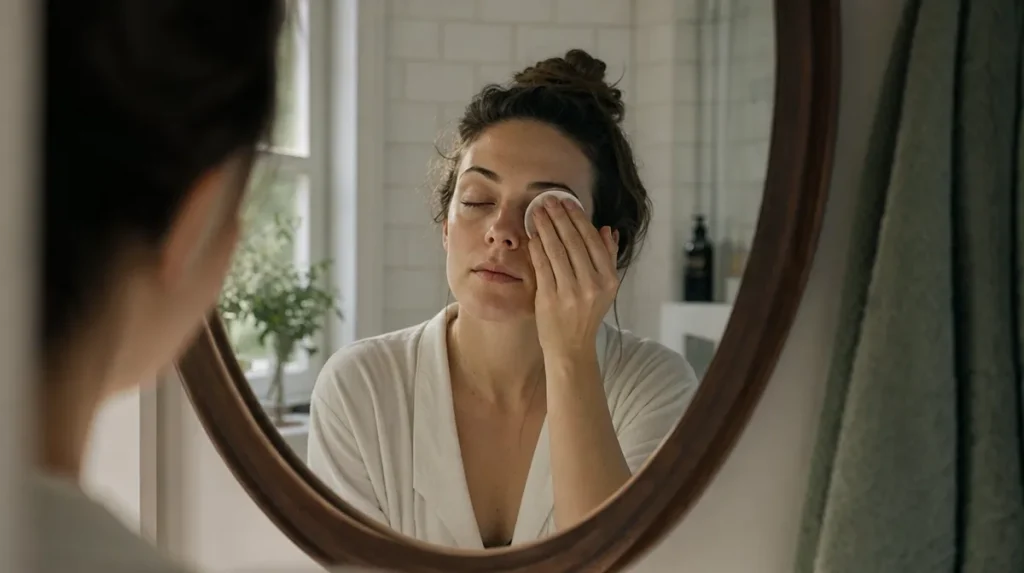
A gentler method: soak a cotton pad with a dedicated eye makeup remover, hold it against closed lids for ten to fifteen seconds to let the product dissolve pigment rather than scrub it away, then wipe in one downward motion. Repeat with a fresh pad rather than working the same soiled one back and forth.
This single change, patience over friction, does more for long-term skin comfort around the eyes than most serums marketed for the same purpose.
Key Takeaways
A routine that holds up in daily life comes down to three habits repeated in order: a thin oil-absorbing base before any colour, pigment built in light layers rather than one heavy pass, and blending focused specifically at the edges rather than the centre of the lid. None of this depends on a particular palette. It depends on the sequence.
A Quick Checklist Before You Start
- Check undertone in natural daylight, not indoor lighting
- Apply a thin base across the lid, using a brush or sponge rather than a finger
- Build colour in three light layers: transition shade, lid shade, optional outer-corner depth
- Blend the boundary between shades with a clean, dry brush
- Check wear at the three-hour mark rather than immediately after application
- Remove with a soak-and-lift method rather than rubbing
This article is general information and does not replace advice from a dermatologist or pharmacist about your own skin.
Individual results vary depending on skin type, application method and daily conditions.