
Graham Beattie, Senior Health and Science Editor.
She is standing at the bathroom mirror at half past seven, phone propped against the toothbrush holder, scrolling through a search she has typed a dozen times before: why does my lip gloss disappear by lunchtime. The shelf behind her holds four half-used tubes, two balms with the applicator gone sticky, and a tinted lip oil bought because the packaging looked expensive. None of them last past her second coffee. That shelf is not a failure of willpower. Lips are structurally different from the rest of the face: they have almost no sebaceous glands, no built-in oil film to slow evaporation, and a stratum corneum often five to ten cell layers thinner than facial skin, so moisture and pigment both leave faster than they would from a cheek. Once a routine is built around that fact rather than against it, gloss and tinted balm stop needing constant reapplication and start behaving the way the label promised. This guide walks through how to choose, apply and judge a lip product so it actually survives a working day, without naming a single brand.
- Lips lose moisture several times faster than cheek skin, which is why even a long-wearing formula can fade within an hour if the base layer underneath is wrong.
- Undertone is best judged in daylight, not under bathroom lighting, since artificial bulbs shift warm and cool tones enough to make the wrong shade look right.
- Texture and layering order, not pigment strength, decide how long colour survives a meal, so the method matters more than the marketing claim on the box.
Why Lips Wear Out Faster Than The Rest Of Your Face
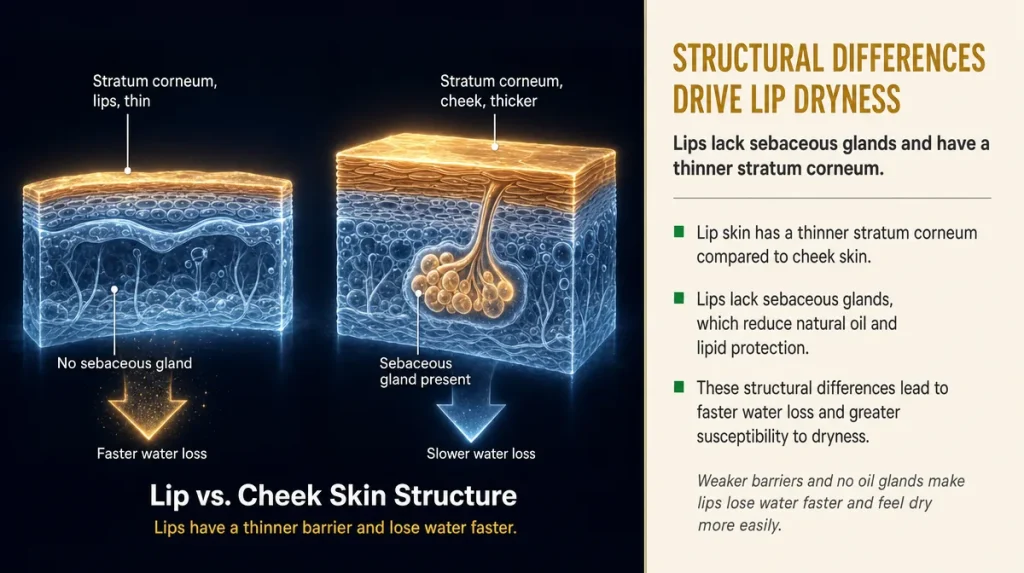
Skin on the cheek or forehead holds its own oil supply, produced continuously by sebaceous glands sitting under the surface. Lips have almost none. The outer layer, the stratum corneum, is also thinner there, often described as five to ten cell layers compared with roughly fifteen on the cheek. That thinner barrier lets water evaporate and pigment migrate far more quickly, in the same way a window without weatherstripping loses heat faster than an insulated wall even when the room behind it is identical.
This is why a gloss or tinted balm that feels matte and long-wearing on the back of the hand can slide off lips within an hour. The surface it sits on simply cannot hold a film the way facial skin does.
A 2021 review in the International Journal of Cosmetic Science noted that lip skin loses transepidermal water at a rate roughly four to ten times higher than forearm skin, which is one reason lip products are formulated with heavier occlusive agents, waxes and film formers than a typical face cream. Understanding this mechanism changes how a product gets chosen: a lightweight, watery gloss that would feel luxurious on a cheek is often the first thing to fail on a mouth that moves, talks, eats and gets licked throughout the day.
None of this means lips need a complicated routine. It means the order and texture of what goes on matters more than the name printed on the tube.
Reading A Tinted Balm Label Without The Marketing Noise
Most tinted balm formulas combine three functional categories, whatever the marketing copy calls them. Occlusive agents, such as waxes or certain esters, sit on top of the skin and physically slow water loss. Emollients, often plant oils or squalane, soften the texture and help the product spread evenly. Pigments, usually micas or iron oxides, provide the tint and sit suspended in the base.
Congress papers presented through the International Federation of Societies of Cosmetic Chemists have long discussed how the ratio of occlusive to emollient ingredients determines whether a balm feels like a second skin or slides off within the hour. A formula heavy on emollients and light on occlusives will feel luxurious on application and disappear fastest. One with the balance reversed may feel slightly heavier at first but holds its tint and comfort far longer through talking, eating and drinking.
Sun protection is worth checking separately. The American Academy of Dermatology has published general public guidance noting that lips are a commonly overlooked site for sun exposure, since they are rarely covered by the sunscreen applied to the rest of the face. A tinted balm that states SPF 50 on the label is doing double duty, and that protection matters on lips just as it does on any other exposed skin.
What rarely matters, despite how it is marketed, is the specific plant extract named in small print beneath the ingredient list. These additions are usually present in amounts too small to change performance meaningfully. The texture test on the back of the hand tells a more honest story than the copywriting on the box.
The Application Method That Actually Holds
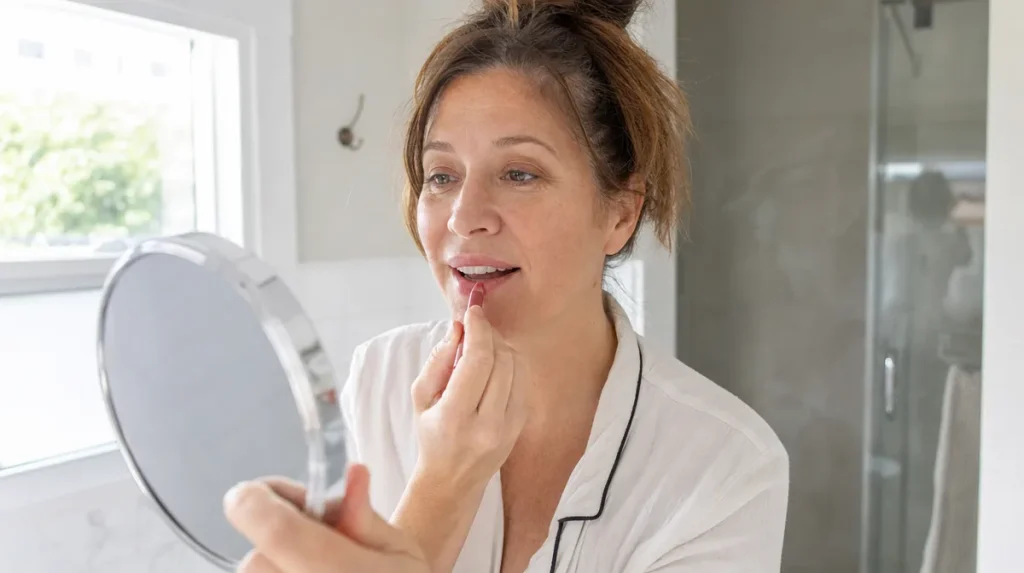
Order matters more than most people assume. Start with lips that are gently exfoliated, never stripped raw, using a soft washcloth or a mild lip scrub once or twice a week at most. Follow with a plain, fragrance-free balm as a base layer and allow it roughly a minute to absorb before adding anything else.
Once the base has settled, apply the tinted product in thin layers rather than one heavy pass. A single thick layer tends to pool at the centre of the lip and migrate into fine lines around the mouth within the hour. Two thin layers, each pressed rather than dragged across the lip, sit flatter and last considerably longer.
After the final layer, press a single clean tissue against the lips for two to three seconds. This removes the surface excess that would otherwise transfer onto a cup or a collar, while leaving the layer that has actually bonded to the skin undisturbed. Skipping this step is one of the most common reasons colour ends up on a coffee cup within the first ten minutes.
If reapplication is needed later in the day, wipe away any remaining product first rather than layering fresh colour on top of what has already begun to break down. Applying new product over old residue is a common cause of the patchy, uneven look that gets blamed on the formula rather than the method.
Finding Your Undertone In Daylight
Bathroom lighting is often the worst place to judge colour. Most bulbs skew warm or cool, which shifts how a tint reads against skin, sometimes making an orange-leaning shade look flattering indoors and oddly muddy the moment the person steps outside.
A simple self-test: stand near a window during daylight hours, turn the wrist palm-up, and look at the veins at the inner wrist. Veins that read closer to green generally indicate a warmer undertone. Veins that read closer to blue or purple generally indicate a cooler undertone. Many people sit somewhere in between, which is entirely normal and simply means a wider range of shades will work.
Shade depth should be described in words rather than by a single brand’s naming system, since those systems vary widely between companies and regions. Thinking in terms of light, medium or deep depth, combined with a warm, cool or neutral undertone, gives a description that holds steady regardless of which shelf the product came from.
The same daylight test works for checking a gloss once applied. A quick glance in a window’s reflection, rather than the bathroom mirror, is a more honest check before leaving the house.
Mistakes That Make Gloss Vanish By Lunchtime
Licking the lips is the single most common habit undoing an otherwise good routine. Saliva breaks down both pigment and the waxy film that holds a balm in place, and it also dries the skin further once it evaporates, prompting more licking in a cycle that wears through product in minutes.
Applying tinted colour directly onto chapped or flaking skin is another frequent error. Pigment settles unevenly into the rough patches, drawing attention to exactly the texture a person was hoping to hide. Treating the dryness first with a plain balm, waiting for it to calm, then applying colour afterwards gives a far smoother result.
Skipping the base layer entirely, to save time, is a false economy. Without it, pigment sits directly on bare lip skin and both colour and comfort fade at roughly the same pace, often within the first hour.
Finally, over-exfoliating is more common than under-exfoliating. Scrubbing daily, rather than once or twice a week, can thin an already delicate barrier further and leave lips more prone to the very dryness the product was meant to disguise.
Judging Results Fairly: How Long To Trial Before Giving Up
A single wear is not enough information. Lips respond differently depending on what the day involves: a quiet day at a desk is a very different test from a day of meals, drinks and conversation. A fair trial covers at least three to five wears across varied conditions before any conclusion is drawn about a product’s staying power.
It helps to note, even briefly in a phone notes app, how many times reapplication was needed and under what conditions: dry indoor heating, humid heat, a long meeting, a meal out. Patterns usually appear within a week. A balm that performs well in dry indoor heat but fades fast in humid heat, for instance, points to a formulation leaning too heavily on waxes without enough humectant support.
Results should also be judged against realistic expectations. Up to several hours of wear before any reapplication is a reasonable benchmark for a well-formulated tinted balm under normal daily conditions; claims of all-day wear with zero touch-ups, regardless of eating or drinking, are rarely borne out in ordinary use and are worth treating with some scepticism.
What Is Worth Paying Attention To, And What Is Simply Packaging
Price positioning varies widely across where lip products are bought, from pharmacy shelves to beauty halls at department stores and duty-free counters, to online retailers such as Sephora, Lookfantastic or Notino that ship widely. A higher price sometimes reflects genuinely different formulation work, and sometimes reflects packaging, marketing spend or limited-edition shade ranges. Texture performance, not shelf price, is the more reliable signal.
Consumer-facing testing bodies such as Good Housekeeping Institute and Which? periodically publish general guidance on lip care and product performance, and that public guidance is a useful starting point for understanding what independent testers look for: wear time, comfort, and how a product performs alongside eating and drinking rather than in isolation. None of this guidance should be read as an endorsement of any particular brand, only as a description of sound testing criteria that a careful shopper can apply herself.
Fragrance-free and dermatologist-tested are useful plain descriptors to look for on a label, particularly for anyone prone to irritation, though neither phrase guarantees long wear. The honest test remains the one described earlier in this guide: a thin base layer, two light passes of colour, a single blotting press, and a few days of varied wear before judging the result.
Key Takeaways
Lips lose moisture and pigment faster than facial skin because they lack sebaceous glands and carry a thinner outer layer. A plain balm base, applied before any tinted product, slows this down more than any single ingredient on the label. Daylight, not bathroom lighting, gives the most honest read on undertone and on how a finished look will actually appear outdoors. Judge any product over three to five varied wears, not one, and track conditions like humid heat or dry indoor heating to understand the pattern. Shelf price reflects packaging and marketing as often as it reflects formulation, so texture performance on the back of the hand remains the more reliable test.
A Simple Checklist Before Leaving The House
- Exfoliate gently, once or twice a week, never daily
- Apply a fragrance-free base balm first and let it settle
- Layer tinted colour thinly, in two light passes rather than one heavy one
- Press with a single tissue to remove excess
- Check the finished colour near a window, not under bathroom lighting
- Wipe away old product fully before reapplying rather than layering over residue
- Track wear across a few different days before judging a product fairly
This article is for general information only and does not replace personalised advice from a dermatologist or pharmacist.
Individual results vary depending on skin type, climate and application method.