
Nathan Pryce, Staff Writer.
There is a drawer in most bathrooms that tells a small story of good intentions: a cleansing brush bought after a glowing recommendation, a charging cable that no longer matches any known device, a spinning head gathering a faint grey film. The question that eventually gets typed into a search bar is rarely “which brush is best”. It is closer to “why does my skin look the same, or worse, after months of this”.
The honest answer is that a cleansing device is only as good as the routine built around it, and most routines are built backwards: bought first, understood second. A 2021 review in the International Journal of Cosmetic Science found that mechanical cleansing devices can lift more surface debris than washing with hands alone, but only when bristle pressure, frequency and cleanser choice are matched to the user’s skin type. Get that matching wrong and the same device that helps one person can leave another with a tight, reactive face by the second week.
This guide is not about which device to buy. It is about the handful of mechanical and habit-based decisions that decide whether a cleansing brush becomes a genuine improvement or an expensive way to irritate your own skin.
- Pressure matters more than power: a gentle 60-second pass with light contact outperforms a hard 30-second scrub on almost every skin type.
- Bristle type should follow skin condition, not trend: soft silicone suits reactive or thin skin, while firmer nylon suits thicker, oil-prone skin, and mismatching the two is the single most common cause of disappointment.
- Hygiene, not horsepower, decides whether results hold up: a device that is not dried and replaced on schedule can reintroduce more bacteria to the face than washing with hands.
What A Cleansing Brush Is Actually Doing To Your Skin
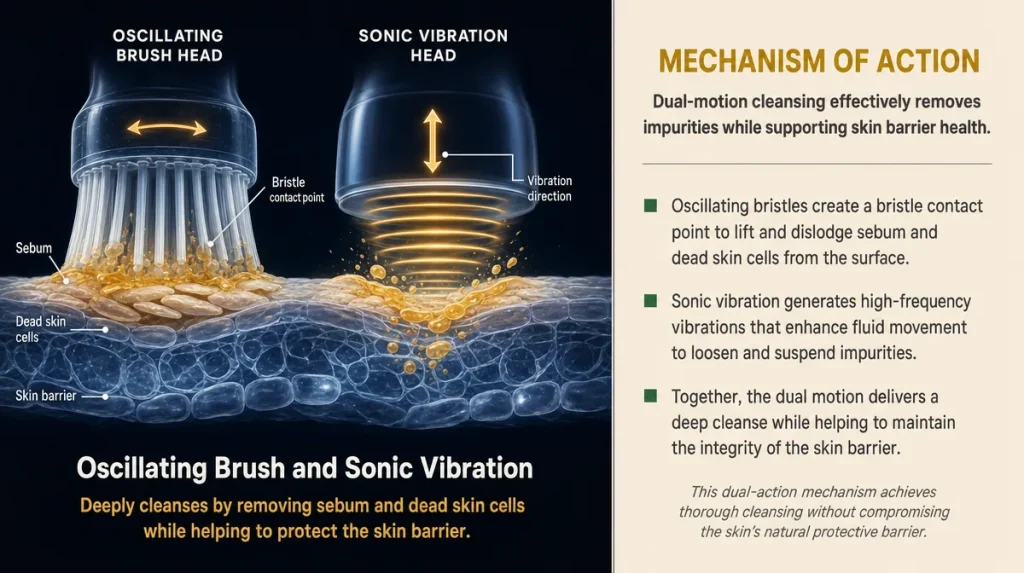
Think of the skin’s surface the way a kitchen sponge behaves on a worktop. A dry cloth wiped over a greasy plate mostly redistributes the grease. Add a little agitation, and the same cloth lifts it away. A facial cleansing brush works on a similar principle: the bristles create tiny, repeated points of contact that help loosen sebum, sunscreen residue and dead skin cells sitting on the surface, so a cleanser can carry them off more efficiently.
This is mechanical exfoliation, not chemical exfoliation. It does not dissolve anything. It simply agitates what is already loosening, in the same way a soft-bristled brush works crumbs out of a rug better than a flat palm.
Most devices fall into two mechanical families: oscillating heads that rotate back and forth, and sonic devices that vibrate at high frequency without full rotation. A 2019 study presented at an IFSCC congress compared surface debris removal across both mechanisms and found the difference between them was smaller than the difference caused by how long and how firmly each device was pressed against skin. The mechanism matters less than the handling.
This matters because marketing often leans on frequency numbers, thousands of oscillations per minute, as though a higher number automatically means a better clean. It does not. Skin is not a countertop. Past a certain point, more agitation simply means more friction on a surface that has a barrier to protect.
Matching Bristle Type To Your Actual Skin, Not Your Aspirational Skin
Bristle firmness is the decision most people skip, and it is the one that decides whether the device feels like a small daily comfort or a daily irritation.
Soft silicone bristles, often finished with a slightly textured or nodule pattern, suit thin, reactive or easily flushed skin. They clean gently and are less likely to cause micro-abrasion. Firmer nylon bristles, arranged in denser clusters, suit thicker skin that tends toward visible oil or congestion, where a gentler bristle may simply not do enough.
A simple self-test: run the bristle head lightly across the inside of your wrist, an area with thinner skin similar in sensitivity to the face. If it feels close to scratchy there, it is likely to be too firm for daily facial use, particularly around the nose and under-eye area.
Skin that runs dry, sensitised, or is being treated with a retinoid or an exfoliating acid should default to the gentlest bristle available, or skip the brush on the nights that active is applied. Dermatologists writing for the American Academy of Dermatology have noted in public patient guidance that combining mechanical exfoliation with chemical exfoliants on the same night is a common cause of over-exfoliation, showing up as redness, tightness or a stinging sensation when normal cleanser is applied.
The fix is rarely to abandon the device. It is usually to separate mechanical and chemical exfoliation onto different nights, and to let the bristle firmness match the thinnest, most reactive part of the face rather than the toughest.
Building A Frequency That Your Skin Can Actually Sustain
The instinct with any new tool is to use it every time it is available. With a cleansing brush, that instinct is usually the fastest route to irritation.
For most skin types, two to three uses a week is a sensible starting frequency, with plain hand washing on the remaining days. Oilier, thicker skin can often tolerate daily use once it has adjusted over several weeks. Skin that runs dry or sensitised often does better capped at one or two uses weekly, treated as a periodic deeper clean rather than a daily habit.
The adjustment period matters. A 2022 study in the Journal of Cosmetic Dermatology followed users introducing a mechanical cleansing device and found that skin barrier markers, including transepidermal water loss, temporarily worsened in the first ten to fourteen days for a portion of participants before stabilising or improving in the following month. In plain terms: a slightly tighter or drier face in week one is not necessarily a sign the device is wrong for you. It may be a sign to slow down the frequency and let the barrier recalibrate.
Timing also matters more than most routines account for. Evening use, before the skin spends hours regenerating overnight, tends to show more visible benefit than morning use, according to dermatology guidance published by the International League of Dermatological Societies on general skincare timing. Morning use on top of a night already spent under a retinoid or acid is one of the more common ways a good device gets blamed for irritation it did not cause alone.
The Mistakes That Quietly Undo A Good Routine
Three mistakes account for most of the disappointment reported with cleansing devices, and none of them involve the device itself being poor quality.
The first is pressure. Users routinely press a vibrating or oscillating head into the face the way they might scrub a dish, when the bristles are already doing mechanical work without added force. Light contact, guided in slow circles, is enough.
The second is duration creep. A recommended sixty seconds of total facial contact time slowly becomes two or three minutes as a habit settles in, particularly around areas that feel congested. Longer is not more effective past the point where debris has already loosened; it simply extends the friction.
The third, and the most overlooked, is using the same cleanser formulated for hand washing with a device that agitates it more intensively. A foaming cleanser with a high concentration of sulfates can feel stronger with mechanical help, stripping more lipid from the skin surface than intended. A cream or gel cleanser with a gentler surfactant base, applied the same way, tends to pair better with mechanical agitation because the cleansing action is already assisted.
A useful check while reading this: after your next use, note whether your skin feels clean or feels squeaky. Squeaky, tight skin immediately after cleansing is rarely a sign of thoroughness. It is usually a sign that too much lipid has been removed, whether by the cleanser, the pressure, or the combination of both.
What Realistic Results Look Like, And On What Timeline

Expectations set by advertising tend to promise change within days. Skin does not generally work on that schedule.
The visible effects most people notice first, smoother texture under makeup and a slightly more even application of moisturiser, tend to show within one to two weeks of consistent, correctly paced use. These come from more effective removal of surface debris and residual product, not from any change in the skin itself.
Deeper claims, reduced visible pore size or a fading of textural congestion, take considerably longer if they occur at all, generally in the range of eight to twelve weeks, and depend heavily on consistent use of the rest of the routine, including sun protection during the day. Dermatologists have noted, in public guidance from the American Academy of Dermatology, that pore appearance is influenced substantially by oil production and skin elasticity, both of which a cleansing device does not directly alter.
A fair way to judge progress is a simple photo comparison taken in the same lighting, at the same time of day, roughly once a month, focused on texture under makeup rather than pore size, which is difficult to judge honestly by eye. If nothing has shifted after twelve weeks of consistent, correctly paced use, the device is not necessarily failing. It may simply not be the right tool for that particular concern, and a conversation with a dermatologist about the specific texture or congestion issue is a reasonable next step.
Reading The Marketing Without Being Led By It
Device packaging leans heavily on numbers: oscillations per minute, sonic frequency in kilohertz, waterproof ratings, app-connected timers. Some of this is genuinely useful. Much of it is not.
Waterproofing to a stated standard is worth checking, since a device used in a shower needs a rating suited to that environment; this is a safety detail, not a marketing flourish. Timers that pulse or beep at set intervals can be genuinely useful for preventing the duration creep described earlier, since they enforce the sixty-second guideline more reliably than a mental count.
Raw frequency numbers, by contrast, tell you very little on their own. As covered earlier, the difference in surface debris removal between mechanisms and frequencies is smaller than the difference caused by pressure and duration. A device advertising a higher number is not inherently gentler or more effective than one advertising a lower number.
App connectivity, facial mapping, and personalised zone settings are conveniences rather than clinical differentiators. They can help a distracted user cover the face evenly, which has some real value, but they do not change the underlying mechanics described above.
The most useful packaging detail, often the smallest print on the box, is the recommended bristle replacement interval, typically every three months with regular use. Bristles that are not replaced on schedule lose their shape and can also harbour bacteria, which brings us to hygiene.
The Hygiene Habit That Decides Whether The Device Helps Or Hurts
A cleansing brush sitting damp in a bathroom, in the same warm, humid environment that also supports mould on tile grout, is not a neutral object. It is a surface that can accumulate bacteria between uses.
Consumer Reports has published general guidance noting that damp bristles left in enclosed, poorly ventilated bathroom storage are more likely to develop bacterial growth than bristles rinsed and left to air-dry openly. The practical habit that follows is straightforward: rinse the bristle head thoroughly under running water immediately after use, shake off excess water, and stand the device upright somewhere it can air-dry fully rather than tucking it into a closed cabinet or a travel case while still wet.
A weekly deeper clean, wiping the head with a mild antibacterial solution or a diluted rubbing alcohol suited for cosmetic tool cleaning, catches what daily rinsing misses. Bristle heads themselves should be replaced on the schedule printed on the packaging, generally every three months with regular use, sooner if bristles begin to splay or discolour.
Self-test worth doing right now: check the last time your current brush head was replaced. If you cannot remember, or if it has visibly changed shape or colour since it was new, that is a more useful signal to act on than any claim on the box it came in. A fresh, well-dried bristle head does more for results than any upgrade in oscillation speed.
Key Takeaways
A cleansing brush is a mechanical helper, not a treatment. It works by loosening surface debris so a cleanser can remove it more effectively, and the mechanism used, oscillating or sonic, matters far less than pressure and duration.
Match bristle firmness to your most reactive skin area, not your toughest. Build frequency slowly, expect a short adjustment period, and separate mechanical exfoliation from chemical actives on the same night.
Judge results over weeks, not days, using consistent photos rather than memory. And treat hygiene as part of the routine rather than an afterthought: a clean, air-dried, regularly replaced bristle head does more for skin than any number printed on the packaging.
A Quick Checklist Before Your Next Use
- Rinse and fully air-dry the bristle head after every use, away from closed cabinets
- Use light contact and slow circles rather than pressing the device into skin
- Cap total facial contact time at around sixty seconds
- Skip the device on nights you apply a retinoid or acid exfoliant
- Start at two to three uses weekly and adjust based on how skin feels after ten to fourteen days
- Replace the bristle head roughly every three months, sooner if it splays or discolours
- Judge results with monthly photos in consistent lighting, not day-to-day impressions
This article is general information and does not replace individual advice from a dermatologist or pharmacist.
Individual results vary depending on skin type, routine and consistency of use.