
Isla Fenwick, Features Reporter.
You are holding two bottles of what the label calls gel-effect polish. Both promise the same glassy, salon finish. Both cost roughly the same. One will still look wet-shine glossy on day five. The other will be tip-chipped by day two, and you will not know why until it happens again.
That is the real question most buyers are actually typing into a search bar at midnight, half-frustrated, nail file in hand: why does this never look like it did at the salon. The honest answer has less to do with luck than with a handful of things a formulator or a dermatologist would check before ever swiping colour onto a nail plate.
One useful fact to start with: gel-effect polish is not gel at all. It is an air-dry lacquer engineered with flexible, high-shine polymers to mimic the look of a UV-cured gel manicure, without the lamp. That single distinction explains most of what follows.
- Gel-effect means air-dry, not lamp-cured, so its durability depends on film flexibility rather than UV chemistry, and judging it by gel-manicure standards sets you up to be disappointed.
- The base coat, not the colour, decides most of the lifespan, because adhesion failure at the nail bed is the mechanism behind almost all early chipping.
- A simple drip and swipe test in the shop tells you more than the label, and it takes under a minute to do properly.
Telling Gel-effect From True Gel Before You Buy
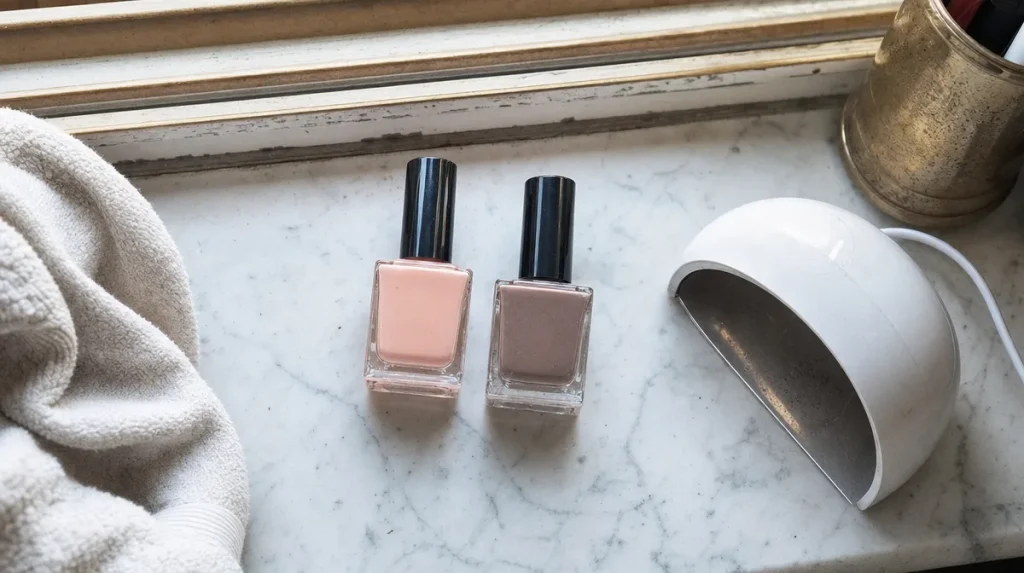
The word gel on a bottle does two very different jobs. A true gel polish is a resin that stays soft until UV or LED light triggers a chemical reaction, hardening it into a durable, slightly rubbery film. Gel-effect polish is ordinary nitrocellulose lacquer with added flexible polymers and high-shine resins, drying the normal way, through solvent evaporation in air.
Think of it like the difference between epoxy resin and a fast-drying varnish that has been formulated to look glossy and thick. Both can look similar wet. Only one is chemically locked in place.
This matters because a gel-effect polish will always move more with the nail as it flexes, which is both its advantage (less brittle cracking) and its limit (more prone to edge wear where the nail meets a hard surface repeatedly, such as keys or a laptop lid).
A quick way to check which you are holding: true gels are almost always sold with, or explicitly paired to, a specific lamp, and the bottle will say so. If there is no mention of curing time or lamp wattage anywhere on the packaging, you are looking at gel-effect lacquer, and your expectations should shift accordingly.
The International Federation of Societies of Cosmetic Chemists has published congress papers on film-forming polymers used in both categories, and the underlying chemistry described there is genuinely different, not just marketing language dressed up two ways.
The Drip Test: Reading Viscosity At Home
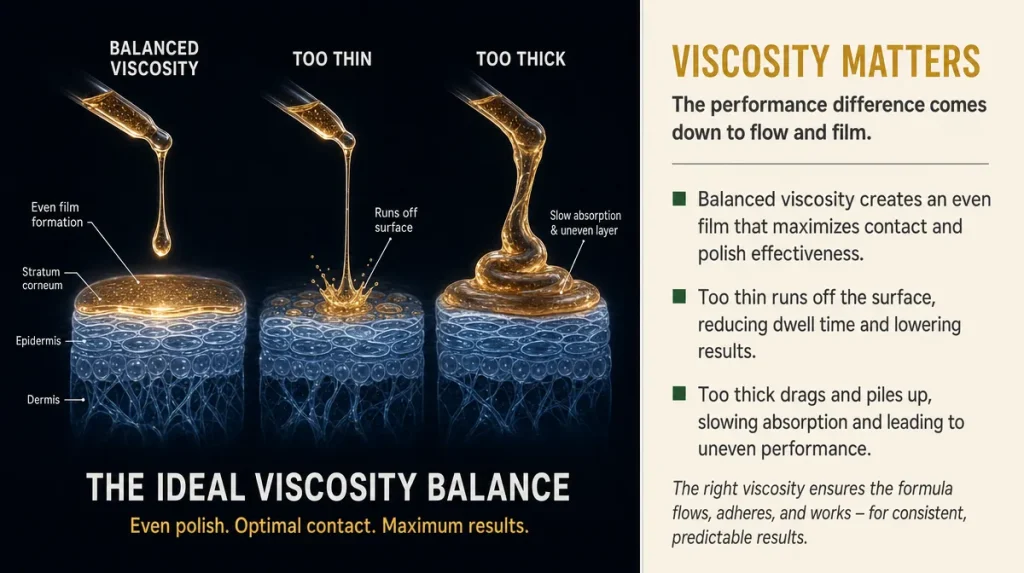
Before you swatch anything, tilt the bottle and watch how the polish moves on the brush as you lift it out.
A well-balanced gel-effect formula drips in a slow, even ribbon and rejoins itself within a second or two, like warm honey settling back into a jar. If it strings out into thin, uneven threads, or pools unevenly on the brush, the resin-to-solvent ratio is off, and streaking during application is likely.
Step by step: open the bottle, wipe the brush once against the bottle’s neck as usual, then hold it a few centimetres above the open bottle for three seconds. Watch the drip.
Too thin, and the polish will need three or four coats to build opacity, which increases drying time between coats and raises the odds of smudging. Too thick, and it will drag, leaving visible brush marks that no amount of top coat can fully disguise.
Most specialists testing colour cosmetics for durability, including the methodology described publicly by Consumer Reports for its lacquer testing, note viscosity consistency across a batch as one of the first quality checks, well before shade or shine are assessed. You can approximate the same check in under a minute, standing at a counter in a shop such as Sephora or Lookfantastic, or even at a pharmacy nail aisle, before you commit to a purchase.
Why The Base Coat Decides More Than The Colour
Ask any cosmetic chemist what fails first on a manicure and the answer is rarely the colour coat. It is the bond between the nail plate and whatever sits directly on it.
The nail plate is naturally slightly oily and uneven at a microscopic level. A base coat’s job is to fill those irregularities and create a surface the colour can grip, rather like a primer evening out a wall before paint goes on. Skip it, or use one mismatched to the topcoat’s chemistry, and the whole system can lift as a single sheet, usually starting at the free edge or a cuticle corner.
The American Academy of Dermatology’s public guidance on nail care notes that repeated product removal and reapplication without allowing the nail to rest can itself weaken this bond over time, independent of which formula is used.
A mistake worth naming directly: many buyers blame the colour polish for chipping when the real fault sits one layer down, in a base coat that was old, applied too thin, or simply incompatible with an unusually flexible gel-effect topcoat. If you are testing a new colour and it fails within a day, try it again with a fresh, unrelated base coat before writing off the lacquer itself. The variable you changed tells you where the fault actually lives.
Judging Shine Without The Shop’s Lighting
Shop lighting is designed to flatter everything on the shelf, which makes shine an unreliable thing to judge on the spot. A better approach is to look at how a dried swatch behaves under two different light sources you already carry with you: a phone torch, and ordinary daylight from a window.
High-shine gel-effect resins reflect light as a single, unbroken highlight, similar to the sheen on a still pond rather than the scattered glare off rippled water. If the swatch looks glossy under direct light but slightly cloudy or matte at an angle, the formula may rely on a heavy topcoat for its shine rather than genuine film clarity, meaning the gloss will fade faster as that top layer wears at the edges first.
A simple self-test: swatch a small patch on an old nail or a piece of dark card, let it dry fully (most gel-effect lacquers need at least ten minutes without a lamp), then tilt it slowly under a window. Even, unbroken light movement across the surface is the sign of a genuinely high-shine resin system, not just a thick top coat doing the visual work.
Good Housekeeping Institute’s published testing notes on cosmetic durability distinguish between initial gloss and gloss retention for exactly this reason: the two are measured separately because they do not always move together.
What Actually Causes Chipping By Day Two
Early chipping almost always traces back to one of three things: oil left on the nail plate before application, coats applied too thickly to cure evenly through their full depth, or contact with hot water too soon after painting.
Oil is the quiet saboteur. Hand cream, cuticle oil, even the natural sebum on freshly washed hands, all sit between the nail and the polish like a layer of cling film between two pieces of tape. Nothing sticks properly through it. Wiping the nail plate with a lint-free pad and a little isopropyl alcohol immediately before painting removes this layer and is a step most home manicures skip entirely.
Thick coats are the second culprit. A coat that looks perfectly opaque wet can still be soft underneath a dry-feeling surface twenty minutes later, because solvent trapped deeper in the film has not fully evaporated. Pressing on gloves, keys, or a hot mug at that stage dents the still-soft layer beneath, and that dent becomes the starting point for a chip.
Hot water in the first hour, from washing dishes or a shower, softens the still-curing film and lets it separate at the edges. This is true of gel-effect formulas more than people expect, precisely because they never chemically lock the way a lamp-cured gel does.
A 2021 study in the International Journal of Cosmetic Science measuring lacquer adhesion under repeated water exposure found wear concentrated almost entirely at the free edge and tips, which matches where most people report their first chip appearing.
One Coat Or Two: Reading Pigment Load Honestly
A polish that reaches full colour in a single coat is not automatically better made than one needing two. It usually means more pigment has been loaded into the same volume of resin, which can affect flexibility, since pigment particles do not bend the way the resin around them does.
A useful household comparison: think of pigment like sand mixed into paint. A little sand thickens the texture slightly but the paint still spreads and flexes normally. A lot of sand, and the dried film becomes noticeably more brittle, prone to fine cracking under stress even though it looked identical while wet.
This is why some of the most durable gel-effect formulas are deliberately built to need two thinner coats rather than one heavily pigmented one: the resin-to-pigment ratio in each individual layer stays more favourable to flexibility, even though the total pigment applied ends up similar.
When comparing formulas, look at the difference between the first and second coat rather than judging on the first alone. If the second coat noticeably deepens or evens out the colour with minimal extra thickness, the pigment is well dispersed. If it takes a visibly heavier second coat to fix patchiness left by the first, dispersion is likely uneven, and long-term durability may follow suit.
Mistakes In Application That Look Like Bad Formula
Several of the most common complaints about gel-effect polish are actually about technique, not chemistry, and it is worth ruling these out before blaming a formula.
Painting too close to the cuticle or side walls leaves a thin film of wet polish sitting on skin rather than nail. That film dries as a fragile edge that peels within a day, and it is often mistaken for the whole manicure lifting when only the border ever failed.
Not waiting long enough between coats is another. Gel-effect lacquers are formulated to be touch-dry within a couple of minutes precisely so buyers apply the next coat too soon, trapping solvent between layers. That trapped solvent keeps softening the film from within for hours after the surface looks finished.
A capping stroke, a single light sweep of the brush along the free edge of the nail with each coat, seals that vulnerable tip and is one of the simplest habits separating a manicure that lasts from one that does not, regardless of which bottle is used.
Which?’s general consumer guidance on cosmetic product testing notes that user error is routinely a larger factor in perceived product failure than formula defects, across categories well beyond nail care, and it is worth remembering that before assuming the polish itself is at fault.
Timing The Verdict: Judging Results At 48 Hours And Beyond
Judging a gel-effect polish on day one is judging it at its easiest moment. The honest test window is 48 hours, once the film has fully hardened through its depth and been through at least one round of hand washing, hot water, and normal friction against clothing or keys.
At that point, look specifically at the tips and the point where the nail curves over the fingertip, since that is where flex and contact concentrate stress. Fine, hairline cracking there is a sign of a formula on the more brittle end. Colour that has thinned unevenly across the nail bed, rather than chipped, usually points to solvent evaporation issues rather than adhesion.
Give it the full run before deciding. A formula that looks merely acceptable on day one but is still glossy and unchipped on day five has told you something a same-day swatch cannot: that its film genuinely holds up under real wear, not just under shop lighting. Results vary from one person’s hands and habits to another’s, and a formula that performs well for someone who does manual dishwashing daily may perform differently for someone who does not.
Key Takeaways
Gel-effect polish is air-dry lacquer built to mimic gel shine, not a lamp-cured gel, and that distinction should shape what you expect from it before you ever open the bottle.
Most early chipping traces back to the base coat, oil left on the nail, or coats applied too thickly to cure through fully, rather than to the colour polish itself.
A short viscosity check on the brush, a swatch judged under two different light sources, and a genuine 48-hour wear test will tell you more than any claim printed on the box.
A Quick Checklist Before You Buy Or Judge A Formula
- Check the label for lamp or curing instructions: none present means gel-effect, not true gel
- Do the drip test on the brush before swatching: look for a slow, even ribbon
- Wipe the nail plate with a lint-free pad before applying any base coat
- Apply coats thin, wait the full drying time between them, and cap the free edge with each coat
- Judge shine under daylight and a phone torch, not shop lighting alone
- Avoid hot water or heavy hand contact for at least an hour after painting
- Withhold judgement until the 48-hour mark, once the film has fully cured through its depth
This article is general information and does not replace personalised advice from a dermatologist or pharmacist.
Individual results vary depending on nail condition, application technique and daily habits.