

Dermatologist: “In 20 years of oculoplastic practice, the question I hear most is why most eye creams barely seem to do anything besides surface-level hydration. The answer is that eye-area skin is biologically 22 years older than the rest of your face, with 3 layers of protective structure instead of 15, and almost no product on the market is formulated for that.” – Marcus Bauer, PhD
SCIENCE & AGING
Verified by board-certified dermatologists • Tested in ISO-certified research laboratories • 128 eye creams analyzed
You look fine in the mirror. You check in the morning and things seem alright. Maybe a little tired, but nothing that worries you.
Then you see a photo someone else took, or catch your reflection in daylight, and the woman looking back seems ten years older than the one in your bathroom mirror.
The dark circles you thought were just a bad night’s sleep. The lines that weren’t there six months ago. That hollow look under your eyes that makes you look exhausted no matter how well you slept. “Are you tired?” your colleague asks. You slept eight hours.
You’ve tried the eye creams. The $30 one, the $80 one, the $125 one from the dermatologist’s office. They all did something for a week or two, then stopped. And you’ve started to wonder if it’s you. Maybe you’re not applying it right. Maybe you need more sleep. Maybe this is just what happens when you get older and there’s nothing you can do about it.
It’s not you. And there is something you can do about it. But first you need to understand why every eye cream you’ve tried has failed in the same way.
My name is Marcus Bauer, PhD. For 20 years as an oculoplastic specialist, I watched patients cycle through eye cream after eye cream. The same pattern every time. A few weeks of hope, then right back to the same dark circles, the same tired look. I didn’t have a good answer for them. Until last year.
That’s when an independent panel of dermatologists and cosmetic chemists set out to answer a question that nobody in the skincare industry seemed willing to ask: why do all eye creams eventually stop working?
They tested 128 eye creams over 12 weeks using clinical-grade 3D imaging. They measured how much crow’s feet reduced. Whether dark circles visibly faded. How much firmness returned under the eyes. And, most importantly, whether any of it held past the two-week mark where most eye creams quietly stop doing anything.
Out of 128, only 5 passed.
The results unsettled even the researchers. Some of the most trusted luxury brands scored below drugstore products. One of the most expensive eye cream brands in the world didn’t even make the top 10. And the serum that ranked first is one most women have never heard of.
What the panel discovered wasn’t just which products worked. They discovered why 123 of them shared the same structural limitation, and what the 5 that passed were doing differently at a biological level.
This investigation explains what those five products are, what they found, and why it changes how you should evaluate every eye cream you’ll ever consider again.
“If You’re 40, Your Eye Skin Is 62”
Before they tested a single product, the panel reviewed a study that reframed everything we thought we knew about eye-area aging.
A team of researchers used epigenetic clocks to measure the biological age of skin taken from different parts of the same face. Not how old the skin looked. How old it actually was at a cellular level, based on the chemical markers that track how far a cell has aged.
What they found was striking. The skin around the eyes was biologically 22.25 years older than the skin on the temples, just a few centimeters away. Upper eyelid skin was even further ahead: 28.75 years older. The study was published in the Journal of the American Academy of Dermatology.
In plain terms, if you are 40 years old, the skin around your eyes is not functioning like 40-year-old skin. It is functioning like the skin of someone who is 62. It repairs slower. It produces less collagen. It holds less moisture. And it has been aging at that accelerated pace your entire adult life.
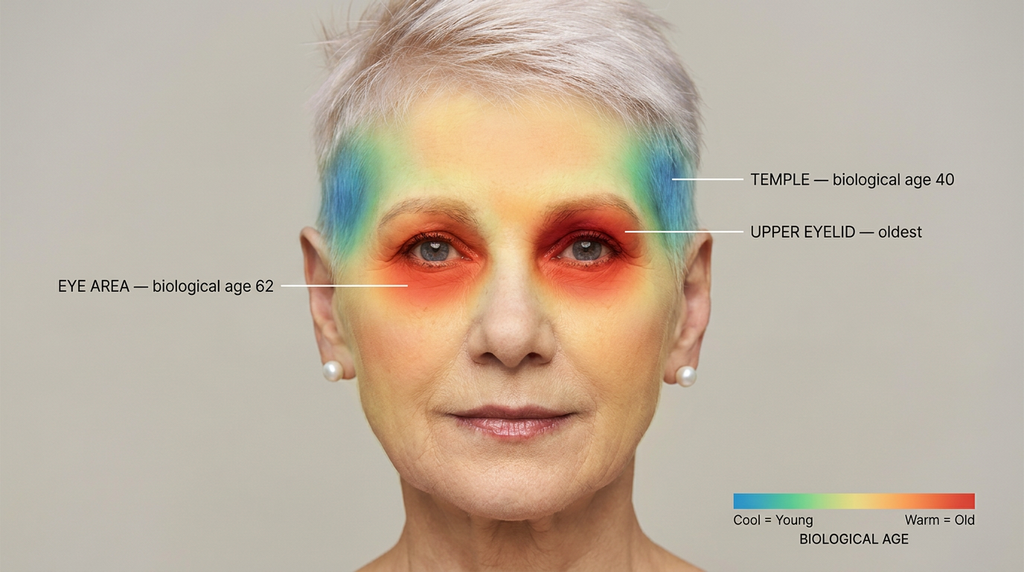
That single finding explains a frustration most women know but can’t quite articulate. A good face cream can make your cheeks and forehead look noticeably better. But the corners of your eyes, the hollows underneath, the thin, dark skin that gives away every late night and every passing year, that part never seems to respond to anything you put on it.
And now you know why. The product was designed for skin that ages normally. Eye skin doesn’t age normally. It’s biologically designed to age faster, on a structure that was already the thinnest and most vulnerable on your body.
A landmark perception study published in the British Journal of Dermatology, conducted across Lyon, Tokyo, Guangzhou, New Delhi, and Cape Town with 600 trained evaluators assessing 180 women’s faces, confirmed what that means in practice: the eye area is the single most powerful predictor of how old you look, across every ethnicity and culture tested.
Not forehead lines. Not nasolabial folds. Not skin texture or tone. The eye area. It’s the first place the human brain scans when judging someone’s age, and it’s the one place that has the fewest biological resources to protect itself.
But the same biology that makes eye skin so fragile also makes it remarkably responsive when you finally target the right mechanisms. The panel identified three specific biological reasons behind the 22-year gap. And when they tested 128 eye creams against all three, only 5 produced measurable reduction in dark circles, under-eye bags, and crow’s feet past the 8-week mark where every other product had stopped improving.
The Three Reasons Eye-Area Skin Ages Up to 5 Times Faster Than the Rest of Your Face, And Why No Product Seems To Work There
What the panel discovered is that the eye area doesn’t just age faster. It ages differently. Three distinct biological processes are happening around your eyes at the same time, and they operate independently of each other. This matters because most eye creams treat all eye aging as if it’s the same problem. It isn’t. And the reason your eye cream eventually stops working is almost always the same: it addresses one of these three processes and leaves the other two completely unchecked.
Cause #1: No natural protection (why moisturizing alone can’t fix dark circles)
The rest of your face has roughly 15 layers in the stratum corneum, the outermost protective barrier of your skin. Your eye area has only 3. Thickness measurements published in Dermatologic Surgery confirm the periorbital zone averages 0.3 to 0.5mm, three to five times thinner than the cheeks.
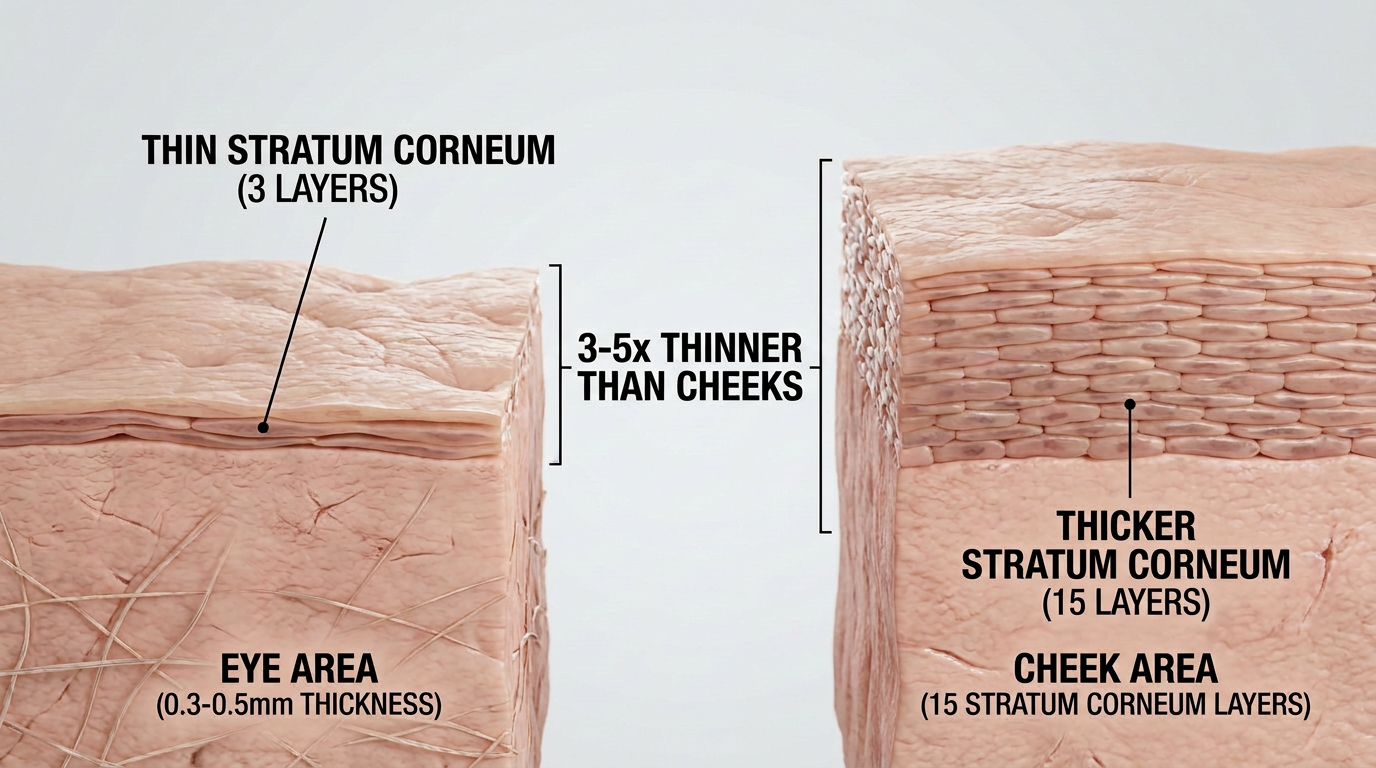
The rest of your face produces oil through sebaceous glands, building a natural moisture barrier against sun damage and pollution. Your eye area has almost no oil glands. No barrier, and no built-in defense.
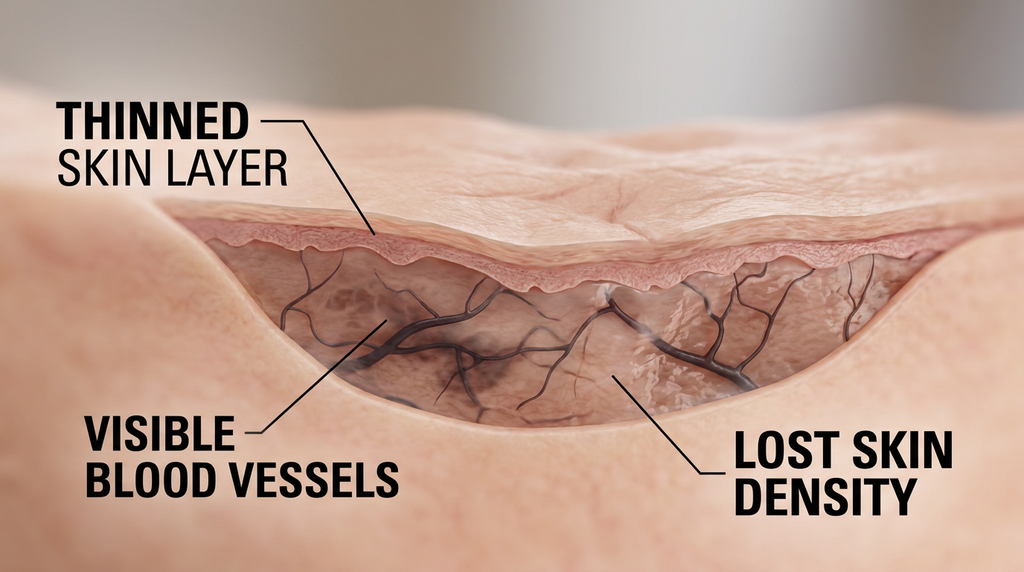
“It’s the most exposed tissue on the human body,” explains Professor Charlotte Weber, MD, board-certified dermatologist and panel lead. “Those dark shadows under your eyes aren’t discoloration. They’re blood vessels showing through skin so thin it’s nearly translucent.”
If you’ve ever wondered why concealer never quite covers your dark circles, this is why. The problem isn’t color. It’s that there isn’t enough skin to hide what’s underneath.
Most eye creams stop here. They moisturize, add a temporary barrier, hydrate what little is there. And for this first cause, many do a decent job. But hydration alone is like adding a coat of paint to a wall that’s crumbling from the inside. The paint looks fine. The wall keeps crumbling.
Cause #2: Constant mechanical stress (why firming creams eventually stop working)
Every day, you blink around 15,000 times. You smile, squint at your phone, rub your eyes when you’re tired. All that movement is constantly folding and stretching the thinnest skin on your body, and it never gets a break.
A study in Experimental Dermatology found that this wear breaks down collagen and elastin around the eyes faster than anywhere else on the face, on skin that’s already 3 to 5 times thinner than your cheeks.
Over time, the entire support structure weakens. The collagen “scaffolding.” The fat pads that give your eye area its shape. Even the bone around the eye socket slowly resorbs with age. When it gives way, crow’s feet become permanent, skin sags, fat pushes forward as bags, and hollows deepen.
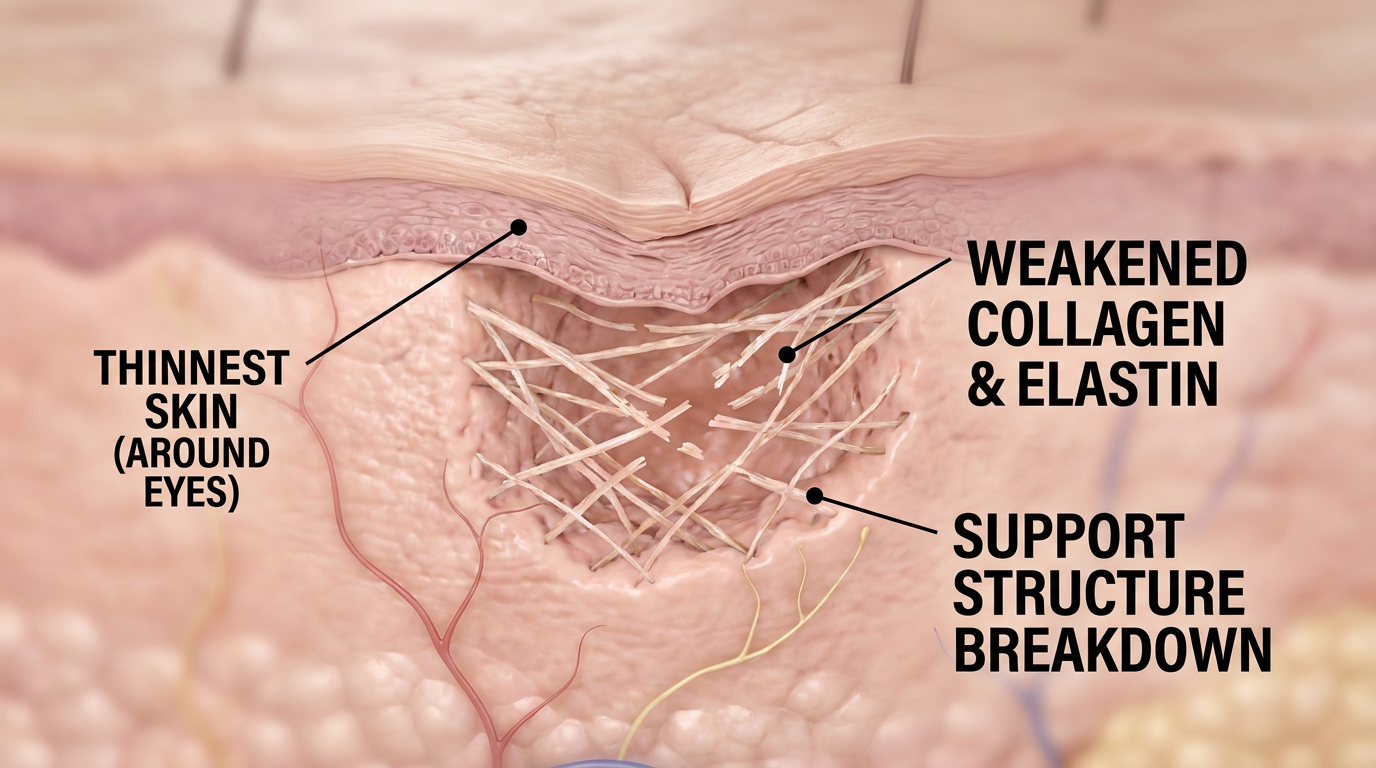
“You can stimulate new collagen with peptides, and you should,” says Dr. Laura Schmidt, MD, FRCP, consultant dermatologist and panel member. “But when 15,000 daily contractions are breaking it down faster than your skin can rebuild it, you’ll see improvement for a few weeks and then it stops. That’s not the product failing. That’s your eyes wearing out the collagen faster than the cream can replace it.”
If you’ve watched an eye cream work for three weeks and then mysteriously stop, this is what’s happening. The cream is rebuilding. Your blinking is tearing down. And the blinking wins, because 15,000 daily contractions is a force no surface-level peptide can outpace on its own.
Cause #3: Loss of skin density (the hidden reason dark circles get worse even with good sleep)
This is the finding that changed the entire evaluation. And once you understand it, you will never look at an eye cream the same way again.
Most women believe dark circles are caused by tiredness, or by pigmentation, or by some kind of discoloration that appeared with age. None of that is quite right.
“The skin around your eyes is about half a millimeter thick, roughly four times thinner than your cheeks,” explains Dr. Laura Schmidt, MD, FRCP, consultant dermatologist and panel member. “Right below this thin skin, you have blood vessels, muscle, and bone. When this skin becomes even thinner with age, due to a natural decrease of hyaluronic acid and collagen, these dark, reddish blood vessels become extremely visible as the skin is too thin to hide them. That’s what people call dark circles.”
Read that again. Those blood vessels that cause dark circles have always been there, even when you were 25. The difference is that younger skin was dense enough to hide them. Older, thinner skin lets them show through.
Think of a sheet of paper placed over a glowing lamp. If the paper is thin, the light shines right through. But a thick piece of cardboard blocks it completely. Your skin works the same way. When the layer between the surface and the blood vessels is thick and full, the dark color stays hidden. When that layer thins out, the vessels start showing through.
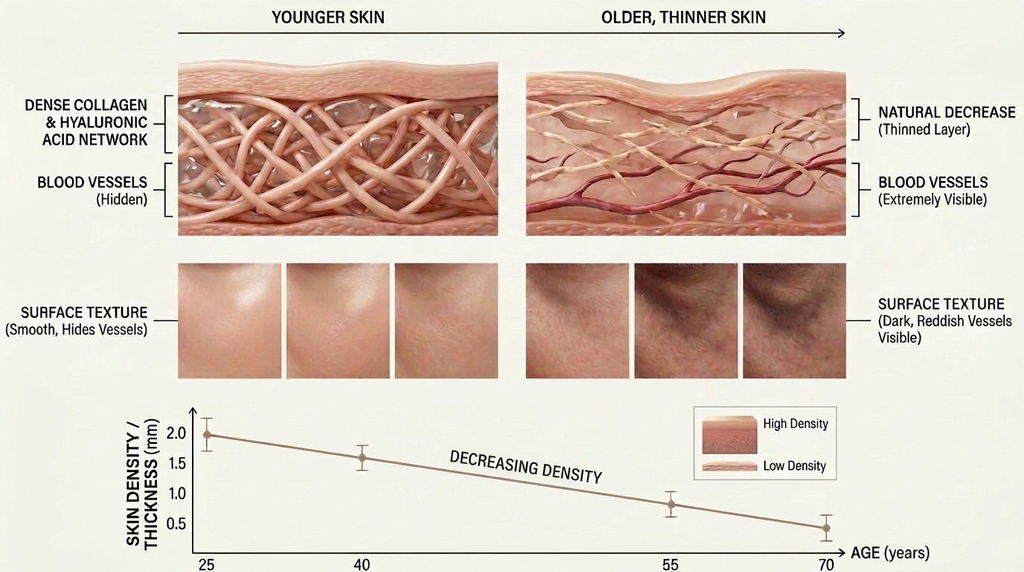
Dark circles are not a stain on your skin. They’re not new pigmentation appearing from nowhere. They are your skin losing enough density that the blood vessels underneath become visible through the surface.
And here is the part that makes this so much more devastating around the eyes than anywhere else. Remember the 3-versus-15 layer difference. The skin on your cheeks has 15 layers of protective structure. Lose 20% of your density from 15 layers and you still have 12 layers of cushion. Plenty left. But your eye area has only 3 layers. Lose 20% from 3 layers and you’re down to almost nothing. There’s barely enough skin left to function as skin, let alone to hide the blood vessels underneath.
This is why 8 hours of sleep doesn’t fix dark circles. Sleep doesn’t make the skin thicker. This is why concealer never quite works. You’re painting over glass. And this is why your eye cream stops working after a few weeks. It was smoothing wrinkles on the surface of skin that was thinning from within. The surface treatment hit its ceiling because the real problem was never at the surface.
The Question No Eye Cream Brand Wants You to Ask: Why Does Eye Skin Get Thinner, and Can Anything Actually Make It Thicker Again?
The main reason it gets thinner is that your skin produces less and less hyaluronic acid every year. HA is the molecule that keeps your skin thick and full at every age. It holds up to 1,000 times its weight in water. It’s the substance that gives young skin its plumpness, its bounce, its ability to hide everything underneath.
When you’re born, your HA levels are at their absolute peak. That’s why babies have such plump, full skin, and why dark circles are virtually non-existent in children.
After 25, production starts dropping and never stops. By 50, your skin has lost roughly half its hyaluronic acid. By 75, nearly 75% is gone.
And the eye area is always the first place to show it, because the skin there is already 4 times thinner than the rest of your face. There’s no margin for error. Every fraction of density lost is immediately visible.
That’s why you can sleep 8 hours for several nights straight and still have those dark hollows under your eyes that make you look worn out. It’s not your skin being tired. It’s your HA stores being depleted. And no amount of sleep will replenish them.
So what can you actually do about it?
Most women try one of three things. Concealer, which hides the color but does nothing about the thinning. Eye creams with hyaluronic acid listed on the label. Or, for those who can afford it, HA filler injections at the dermatologist’s office.
The injections actually work, because they rebuild volume from inside the skin. The principle is right. But they cost $350 to $600 per session, need repeating every year, and carry real risks.
“Most eye products apply hyaluronic acid on the surface of the skin,” explains Dr. Schmidt. “It sits on top and evaporates within hours. It never reaches the deeper layer where the density is actually missing. You’re essentially moisturizing the outside of the glass instead of making the glass thicker.”
Surface creams don’t go deep enough. Injections work but are expensive and temporary. That is the problem 123 of 128 eye creams could not solve.
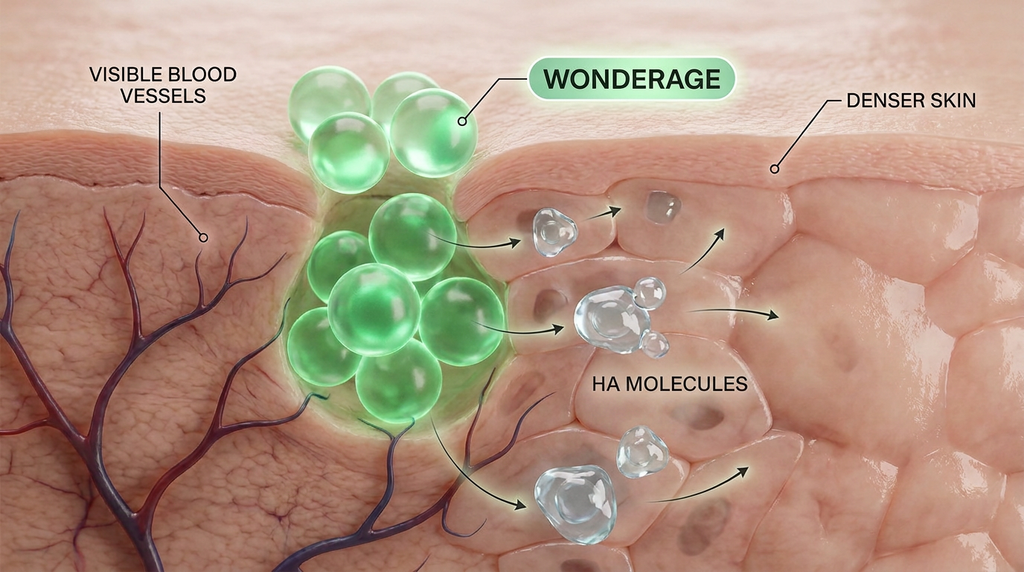
But during the 12-month evaluation, one specific type of ingredient stood out from everything else the panel tested. Instead of adding hyaluronic acid from the outside, it triggers your skin to produce its own HA from the inside. Same principle as injections, volume rebuilt from within, but without the needle.
Think of a kitchen sponge. When a sponge is dry, it’s flat, collapsed, covered in creases. You can smooth those creases all day long. They always come back. The sponge doesn’t have enough substance inside to hold its own shape. Now run water through it. The sponge fills from the inside. It plumps up. The creases smooth out on their own, not because you pressed them flat, but because the sponge has enough internal volume to push outward.
Your skin works the same way. When the dermal layer loses its substance, the skin deflates like that dry sponge. Eye creams try to smooth the surface. What the skin actually needs is to be refilled from within.
In a double-blind, placebo-controlled trial on 44 women aged 60 to 75, this ingredient boosted the skin’s own HA production by 320% in 9 days, and increased skin density under the eye by 56% in 56 days. Dark circles were visibly reduced, not through brightening, not through surface treatment, but because the skin itself became thick enough to hide the blood vessels again.
Several of the top-ranked eye treatments in the panel’s final ranking use this technology. Most of the 123 that failed do not.
Why Most Eye Creams Are Designed to Fail
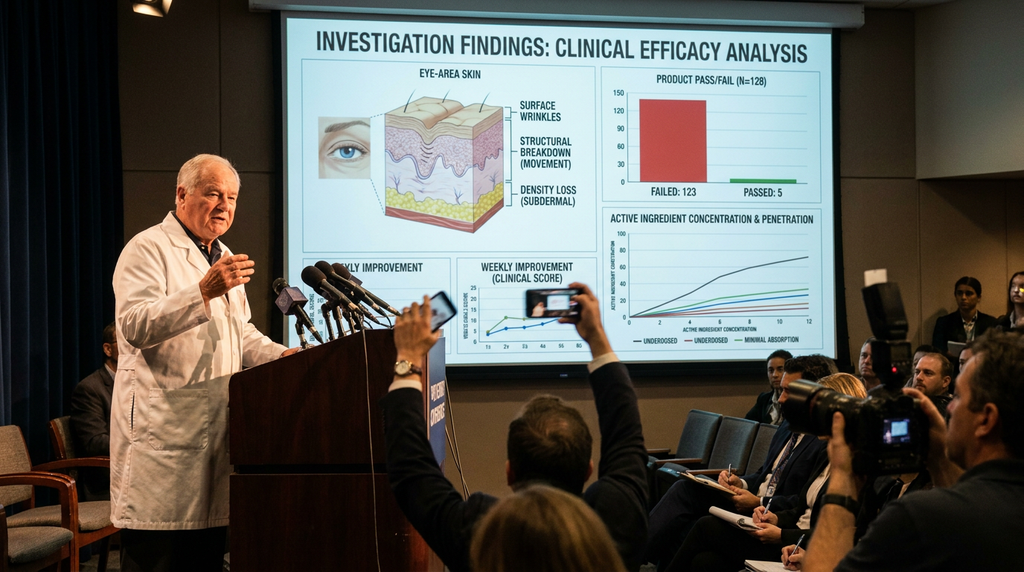
Before revealing the top five, you need to understand why 123 other products failed the testing protocols. And more importantly, why the pattern repeats itself across virtually every price point, every brand, and every country.
We spoke with a cosmetic chemist who spent 18 years formulating products for major beauty brands. What he described explains why your eye cream drawer keeps growing while your dark circles don’t budge.
“Most eye creams are face creams in a smaller jar,” he said. “The brand takes a facial moisturizer, adjusts the fragrance, maybe adds a token peptide, puts it in a 15ml tube and charges twice the price per gram. The formulation isn’t designed for the eye area. It doesn’t account for how thin that skin is, how much it moves, or why it ages completely differently from the rest of the face.”
He continued: “The industry knows there are three distinct problems happening around the eyes. Surface wrinkles, structural breakdown from all the movement, and density loss underneath. But addressing all three requires expensive actives at real clinical doses. It’s much cheaper to add a basic hydrator, call it an ‘eye cream,’ and let the packaging do the selling.”
The panel’s testing exposed exactly this pattern. Of the 128 eye creams evaluated, the majority contained active ingredients at concentrations too low to produce measurable change. Even brands priced above $100 frequently showed no improvement beyond basic surface hydration after 12 weeks of testing.
“That’s what frustrated me most about these results,” noted Dr. Schmidt. “Women blame themselves. They think they need more sleep, or better concealer, or a more expensive product. But the product was never built to address why the eye area actually ages. 123 of the 128 products we tested only addressed one of the three problems. The other two kept progressing unchecked, right under the surface, while the woman believed she just needed to try harder.”
The five products that ranked highest all did something the other 123 structurally could not. They didn’t just moisturize the surface. They reached below it, at concentrations verified to match published clinical research, and addressed the eye area’s three aging processes simultaneously.
Our Scientific Review Board for This Study
To ensure complete independence, all findings were reviewed by an expert panel with no financial ties to any manufacturer:
“Our role was to verify that the testing protocols met clinical standards and that every claim could be traced back to a documented measurement,” says Professor Charlotte Weber, MD. “No manufacturer had any input into the evaluation criteria or results.”
The Independent Testing Protocol
Each product was evaluated using a 14-point system designed specifically for the eye area, measuring how the skin both looked and functioned under the unique conditions around the eyes:
- Active ingredient concentration: verified in the laboratory to confirm the dose was strong enough to work, not just present on the label
- Wrinkle depth reduction: quantified through profilometry and 3D skin scanning of crow’s feet, under-eye lines, and lid creases under standardized lighting
- Skin density measurement: tracked via high-frequency ultrasound to measure the actual thickness of the skin beneath the eye, where density loss causes dark circles
- Collagen and elastin production: tested directly in skin samples to measure structural rebuilding in an area that endures over 15,000 blinks per day
- Firmness and elasticity: tracked with Cutometer R2 readings over the full testing window, focusing on lid sag and under-eye laxity
- Dark circle assessment: measured using colorimetry and Mexameter readings to quantify changes in visible darkness under the eyes
- Under-eye puffiness: monitored through 3D volumetric imaging at consistent times of day to account for natural morning swelling
- Skin hydration: measured with Corneometer readings over 24 hours and across 12 weeks on skin with no oil glands of its own
- Barrier function: assessed via TEWL (trans-epidermal water loss), critical in an area with only 3 to 5 layers of stratum corneum
- Hyaluronic acid activity: tracked whether the formula increased the skin’s own HA production or simply applied it on the surface
- Clinical photography: before and after images captured under identical lighting, with independent grading of perceived age
- Dermatological compatibility: irritation and allergological testing on the most sensitive skin on the face
- Application properties: absorption speed, compatibility with concealer and makeup, and absence of eye irritation or milia formation
- Long-term observation: outcomes tracked over a 12-month period to separate quick depuffing from real structural and density improvement
All products were anonymously purchased from retail sources. Testing was conducted without manufacturer influence, according to standardized protocols under DIN EN ISO 22716 for full reproducibility.
“What set this evaluation apart from anything that’s been done before was measurement number three,” says Professor Weber. “Most eye cream reviews measure wrinkle depth and hydration. They never measure whether the skin itself is getting thicker or thinner. We did. And the moment we added density as a metric, the entire picture changed. Products that looked effective on the surface were doing nothing underneath.”
Key Study Findings
Concentration Is Binary: Either an Ingredient Is Dosed to Work, or It Isn’t
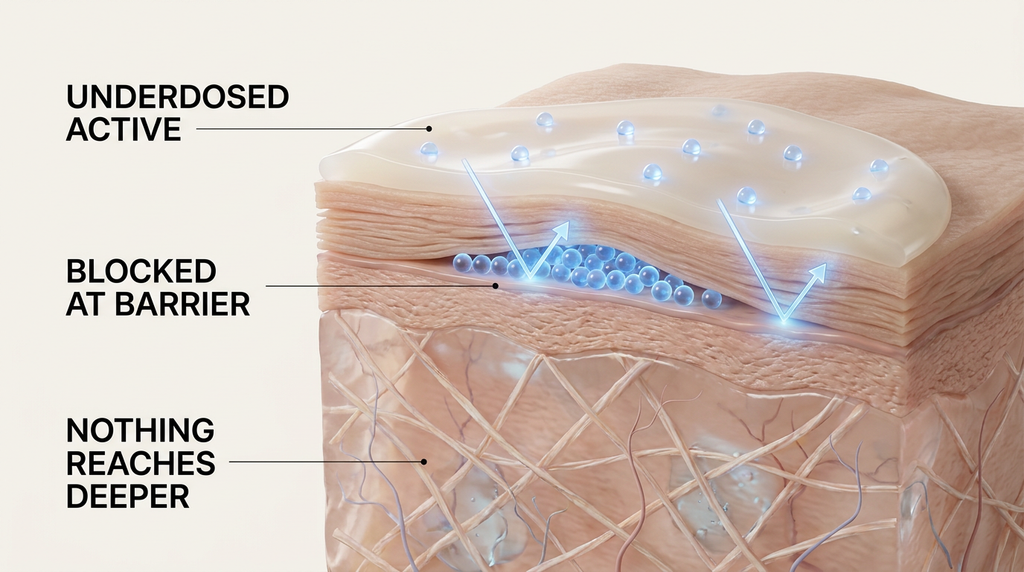
The data told a clear story. The majority of eye creams contained active ingredients at subclinical concentrations, listed on the label but present in amounts too small to produce measurable change. The labels read “peptides,” “retinol,” “hyaluronic acid.” The laboratory instruments read: nothing happened.
“This isn’t a difference of degree. It’s a difference of kind,” explains Professor Weber. “A peptide at 0.001% is label decoration. The same peptide at the clinically studied concentration is a signal that tells your cells to start rebuilding. Same ingredient name. Completely different outcome. With eye products specifically, we see a double failure: the active is already too weak, and the formula often can’t penetrate the eye area’s barrier properly either. So you have a low dose that doesn’t reach where it needs to go.”
Here is the filter the panel used, and the one you can use at home: if a product lists an active ingredient but doesn’t disclose its concentration, assume the concentration is too low to do anything. The brands that dose at clinical levels almost always say so, because the dose is the proof.
Most Eye Creams Only Moisturize. The Actual Problems Keep Getting Worse.
No eye cream built around basic hydration alone produced meaningful improvement in dark circles, under-eye bags, or crow’s feet. Not one.
This matched the most common frustration the panel found in consumer data: “I’ve used eye cream for years and my dark circles never got better.” The reason is now clear. Most eye creams moisturize the surface. They don’t address the structural damage from 15,000 daily blinks that causes sagging and crow’s feet. And they don’t restore the skin density that, when lost, makes blood vessels visible as dark circles.
“The number one complaint about eye creams is that they don’t fix dark circles,” notes Dr. Schmidt. “And the women are right. You can’t fix dark circles with surface moisture. Dark circles happen when the skin becomes too thin to hide the blood vessels underneath. Until a product addresses that thinning, the dark circles stay no matter how much cream you apply. You could use the most expensive eye cream in the world twice a day for a year, and if it doesn’t make the skin denser, the dark circles don’t change.”
The eye creams that scored highest addressed all three problems at once: wrinkles on the surface, structural damage from constant movement, and density loss underneath. The 123 that failed addressed one, or at best two, and left the rest to keep progressing unchecked.
Why the First Two Weeks Are Misleading
Almost every eye cream in the study showed some improvement in the first two weeks. Skin felt softer, fine lines looked smoother, the under-eye area appeared more hydrated. This is the window where most women decide whether an eye cream is “working.” And it’s the window that leads the most women astray.
Hydration is the easy part. Any decent formula can make the eye area look slightly better for 14 days. The problems that actually make you look tired, the structural breakdown and the density loss, require changes that take longer to build and are impossible to fake.
“By week 4, we could see which products had real structural ingredients working underneath,” explains Marcus Bauer, PhD. “Firmness began improving. Crow’s feet started softening. But the visible turning point came around week 8, when density-restoring ingredients began thickening the skin from within. That’s when dark circles started fading. The under-eye area looked fuller. Women looked visibly more rested, not from surface hydration, but because the skin itself was becoming denser and thicker.”
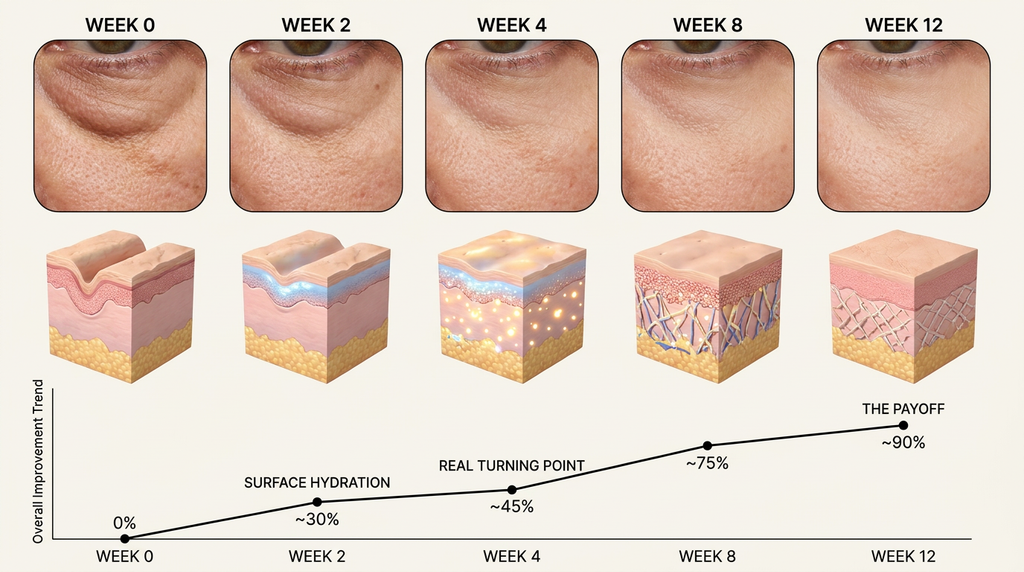
By week 12, women using the top-ranked formulas showed measurably less visible dark circles, fuller under-eye skin, and visible reduction in crow’s feet. Independent assessors rated them as looking up to 5 years younger. The 123 products that failed had stopped producing any visible change before week 8. They hit their ceiling. The 5 that passed never did.
The Active Mechanisms That Made a Visible Difference in Eye Skin Appearance in the Study
Analysis of the top-performing eye creams revealed four types of active mechanisms that consistently separated the 5 that passed from the 123 that failed. Each one works because it reaches a specific layer of eye aging that surface moisturizers structurally cannot.
1. Wonderage (Endogenous hyaluronic acid production)
What it targets: The density loss that causes dark circles. This is the mechanism almost no eye cream on the market addresses, and it is the single biggest differentiator between the top-ranked formulas and everything else in the study.
Most eye creams apply hyaluronic acid on the skin’s surface. It sits on top. It evaporates within hours. It never reaches the deeper layer where the density is actually missing. Wonderage, a botanical active derived from monk fruit, works on a completely different principle: instead of adding HA from the outside, it triggers the skin’s own cells to produce hyaluronic acid from within.
“This is the same principle as HA filler injections,” explains Professor Weber. “Volume restored from inside the skin. But instead of injecting it, the skin is producing it on its own. That is a fundamentally different category of ingredient than anything else we tested.”
In a double-blind, placebo-controlled study on 44 women aged 60 to 75, Wonderage increased the skin’s own HA production by 320% in 9 days. Dermal density increased by 56% in 56 days. Hydration improved by 67%. Some of the top-ranked formulas use this active ingredient at its full clinical dose. The 123 that failed do not contain it.
2. DC Instalift Goji GF (Micro-Peptide Film Technology)
What it targets: The constant mechanical stress from 15,000 daily blinks. The eye area moves more than any other part of the face, and that movement is what tears down collagen faster than most eye creams can rebuild it.
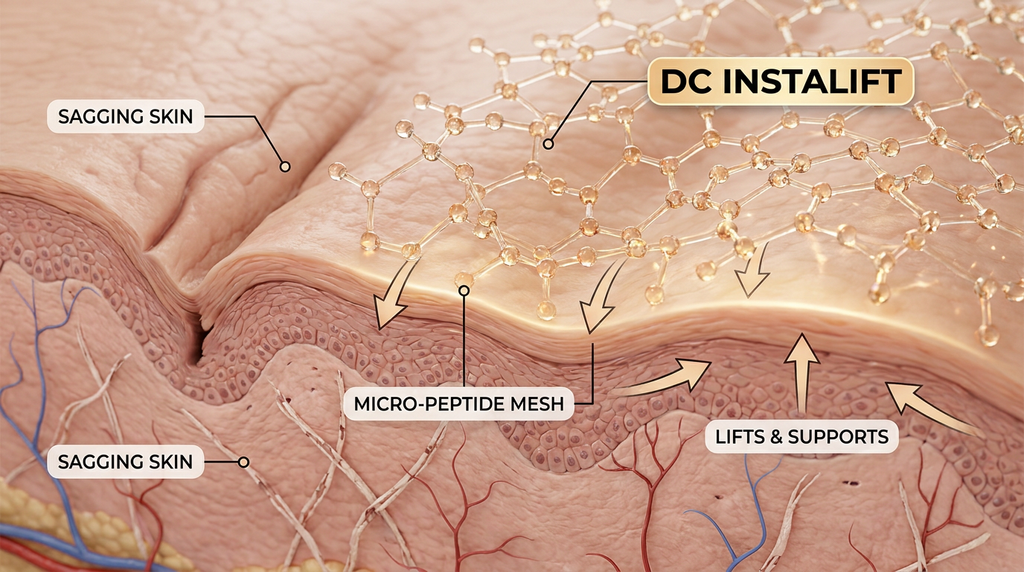
DC Instalift, a glycopeptide derived from goji fruit, addresses this by forming a micro-peptide film on the skin upon application. This film creates a mesh-like structure that physically lifts and supports sagging skin while the longer-term ingredients rebuild underneath. Think of it as a scaffold that holds the skin in place so the deeper repair work isn’t constantly undone by movement.
“It holds the skin in place immediately while the deeper ingredients do their work over weeks,” notes Marcus Bauer, PhD. “Conventional eye creams dissolve into the skin and disappear. This ingredient creates a physical structure that stays, which is why women see a visible difference within minutes, not months.”
Clinical testing showed a 27% improvement in skin firmness within minutes of application, because the mesh physically holds tissue upward rather than temporarily plumping it with moisture that evaporates.
3. Collagen-Rebuilding Peptides (Structural Repair)
What it targets: The structural collapse that causes sagging, drooping eyelids, and deepening crow’s feet. Collagen is the scaffolding that holds your skin firm. Without it, the skin sags inward, and no amount of surface moisturizing can push it back out.
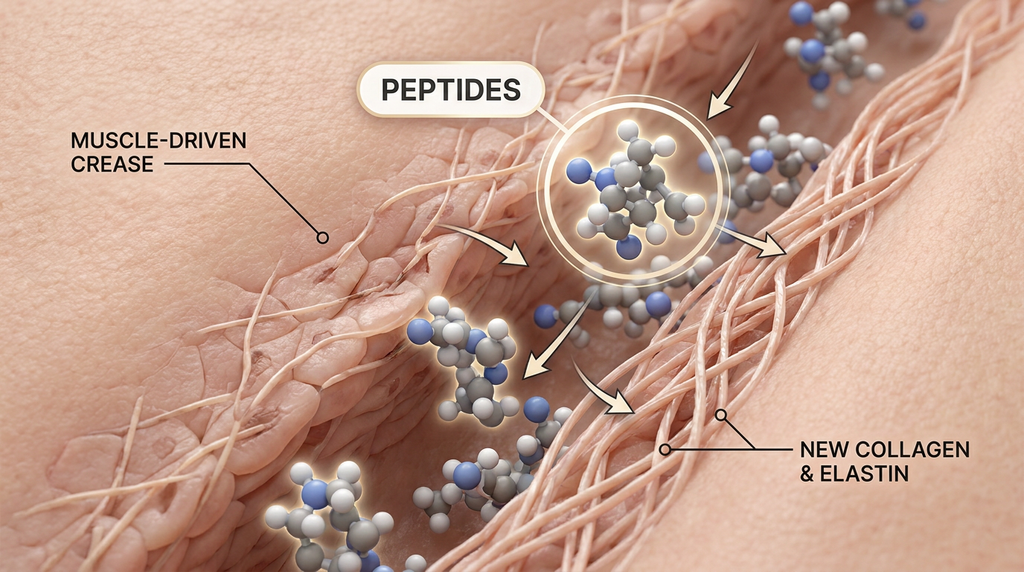
Matrikine peptides, the specific class that produced results in this study, don’t apply collagen from outside. They signal your skin’s own cells to start producing new collagen and elastin from within. This distinction matters because externally applied collagen molecules are too large to penetrate the eye area’s barrier. Matrikines bypass that problem entirely by triggering internal production.
“The eye area loses collagen faster because of the movement,” explains Dr. Schmidt. “A strong matrikine peptide complex doesn’t just slow that loss. It actively rebuilds what’s been broken down. But it must be at the clinically studied concentration, not the label-decoration dose that most eye creams use.”
Clinical studies on advanced matrikine peptides showed a 45% reduction in wrinkle density and 20% improvement in firmness after 2 months of consistent use, because the peptides are signaling the skin’s own cells to build new structure, not applying temporary filler from outside.
4. Wrinkle-Filling Compounds (Surface Smoothing)
What it targets: The visible lines and crow’s feet you see when you look in the mirror. While the deeper mechanisms rebuild density and structure over weeks, wrinkle-filling actives work at the surface, settling into fine lines to physically smooth them from the first application.
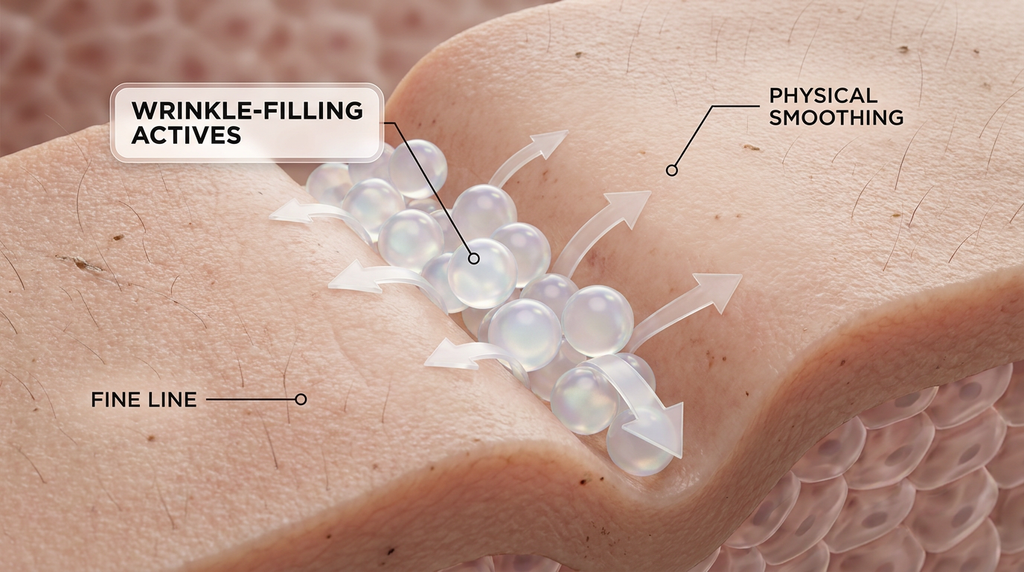
“On its own, surface filling won’t restore density or fix structural damage,” notes Professor Weber. “But combined with the deeper mechanisms, it means visible improvement from day one while the real changes build underneath. That first-day improvement is what keeps women using the product long enough for the density and structural ingredients to take effect.”
In evaluations, this type of ingredient reduced the appearance of fine lines by 50% within 10 minutes, not through long-term repair, but through smart surface engineering that physically fills what time has carved.
Inside the Laboratory Testing
The assessment was carried out by a panel of certified dermatologists specialising in oculoplastic, cosmetic and clinical skin research. All panel members were fully independent, with no financial ties to any of the brands under evaluation.
128 eye creams, from drugstore tubes to luxury-counter formulas, were tested on volunteers over a 12-week window, with outcomes tracked across a full 12-month observation period. Every product was purchased anonymously and stripped of branding before it reached the panel, so no formula was judged by its name or its price.
Each one was then put through the same clinical protocol built specifically for the eye area: profilometry and 3D scanning for wrinkle depth, high-frequency ultrasound for skin density, direct skin-sample analysis for collagen and elastin, Cutometer readings for firmness, colorimetry for dark circles, 3D volumetric imaging for puffiness, and Corneometer and TEWL readings for hydration and barrier strength.
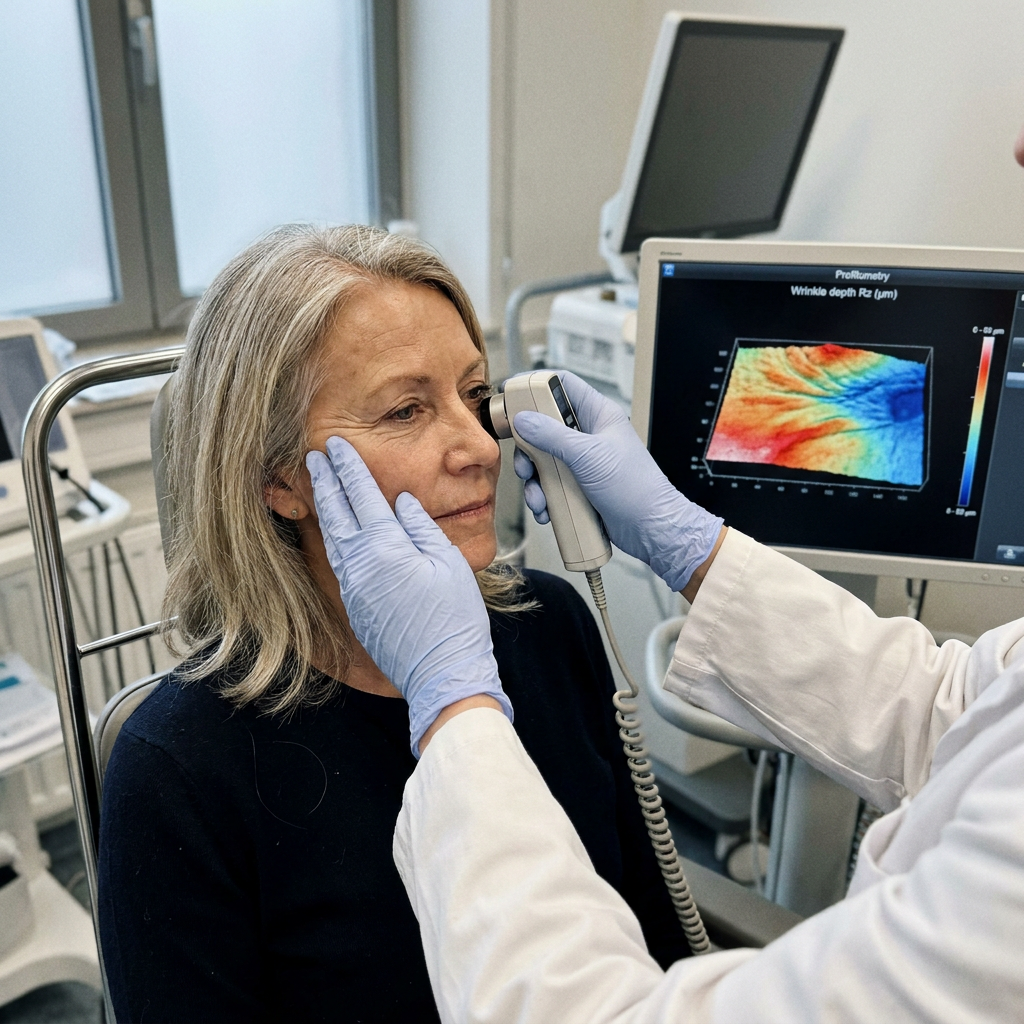
1. Profilometry Scan
3D optical profilometry was used to scan crow’s feet, under-eye lines, and lid creases under standardized lighting, quantifying wrinkle depth in micrometers.
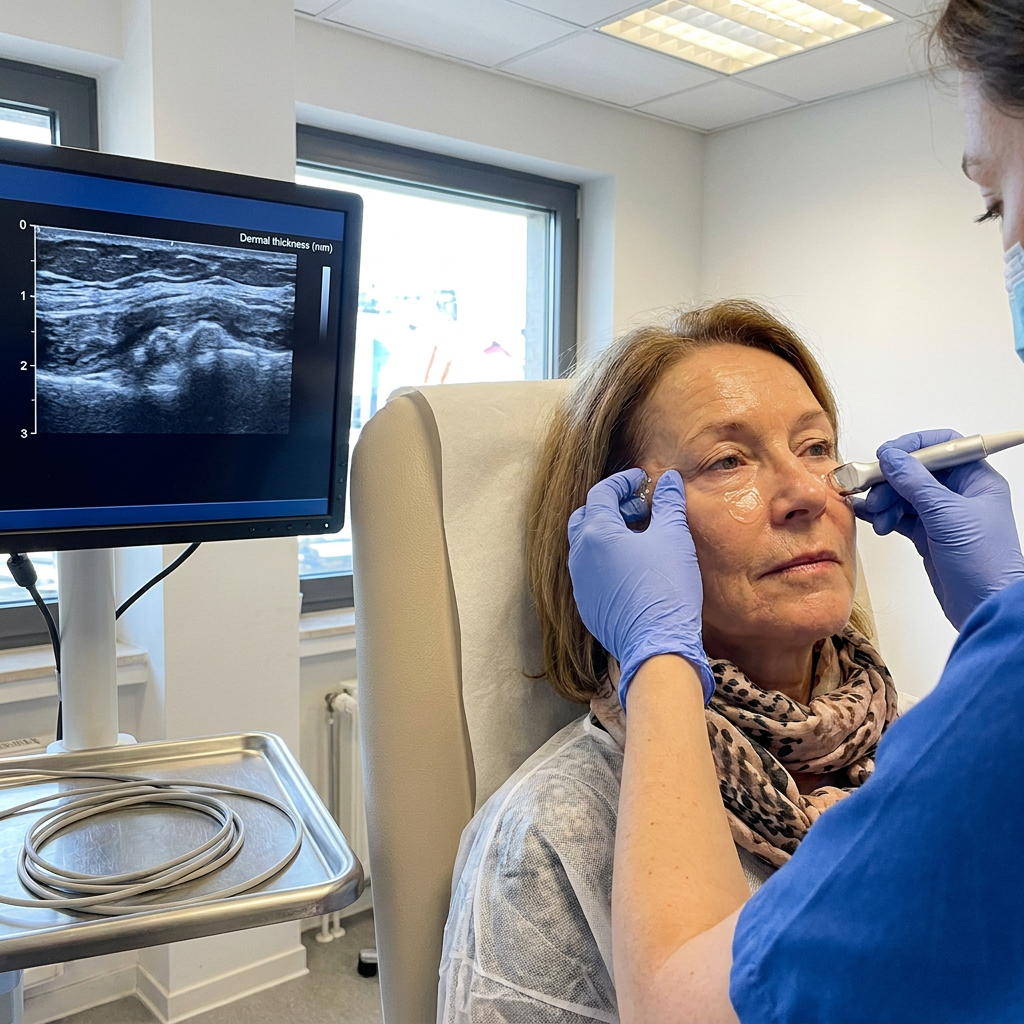
2. High-Frequency Ultrasound
A 20MHz ultrasound probe was used to image the under-eye skin layer by layer, measuring dermal thickness to the micrometer.
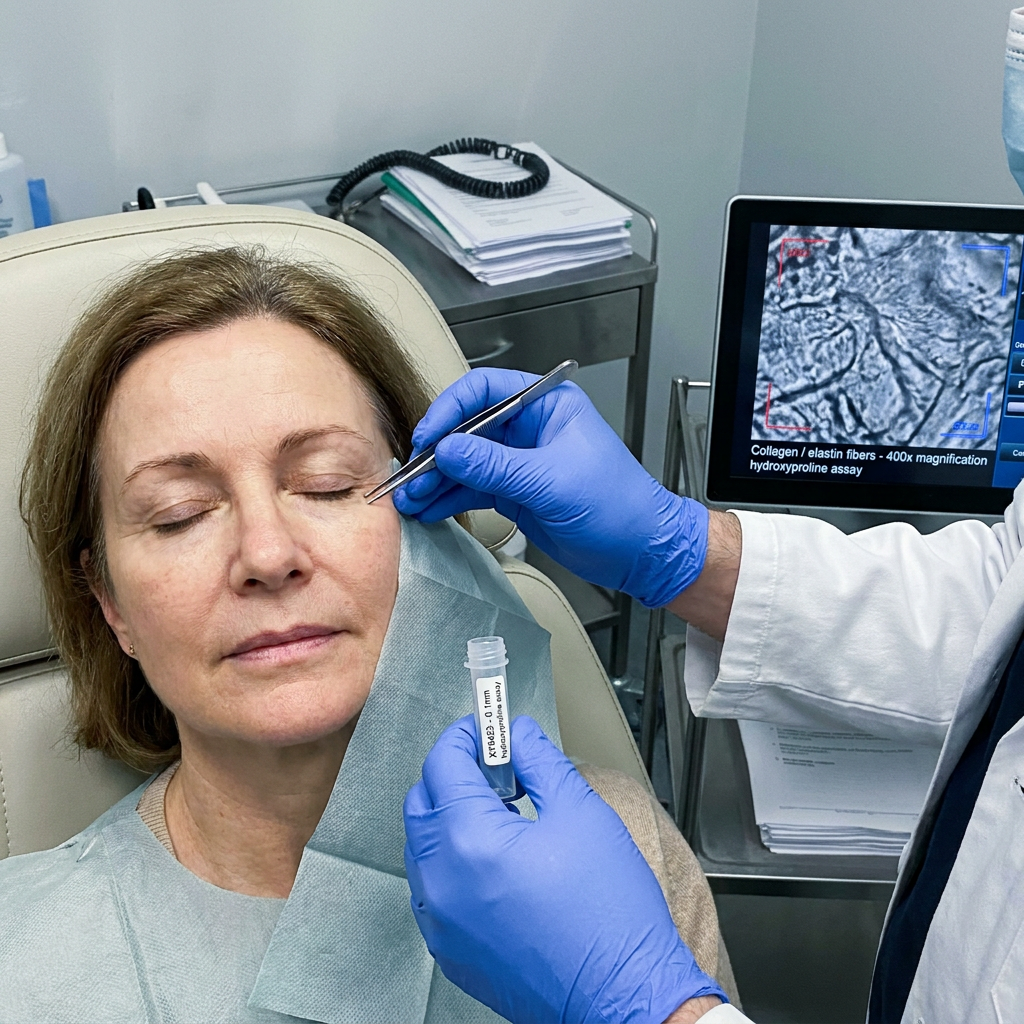
3. Skin Sampling
Periorbital skin samples were analyzed in the lab to quantify new collagen and elastin production via hydroxyproline assay.
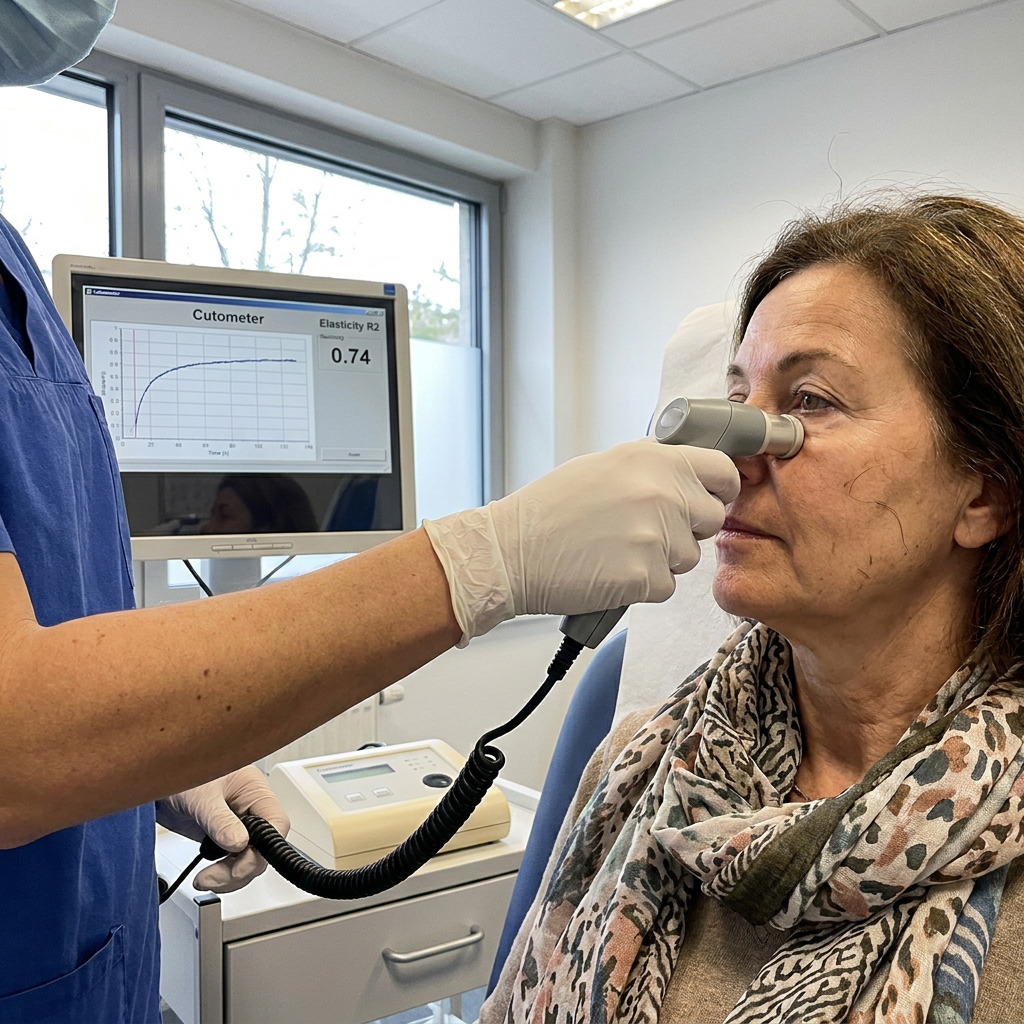
4. Cutometer Reading
A calibrated suction probe was applied to the eyelid and under-eye skin to measure firmness and laxity through R2 elasticity readings.

5. Colorimetry
Colorimeter and Mexameter readings were used to quantify under-eye darkness through melanin and erythema indices.
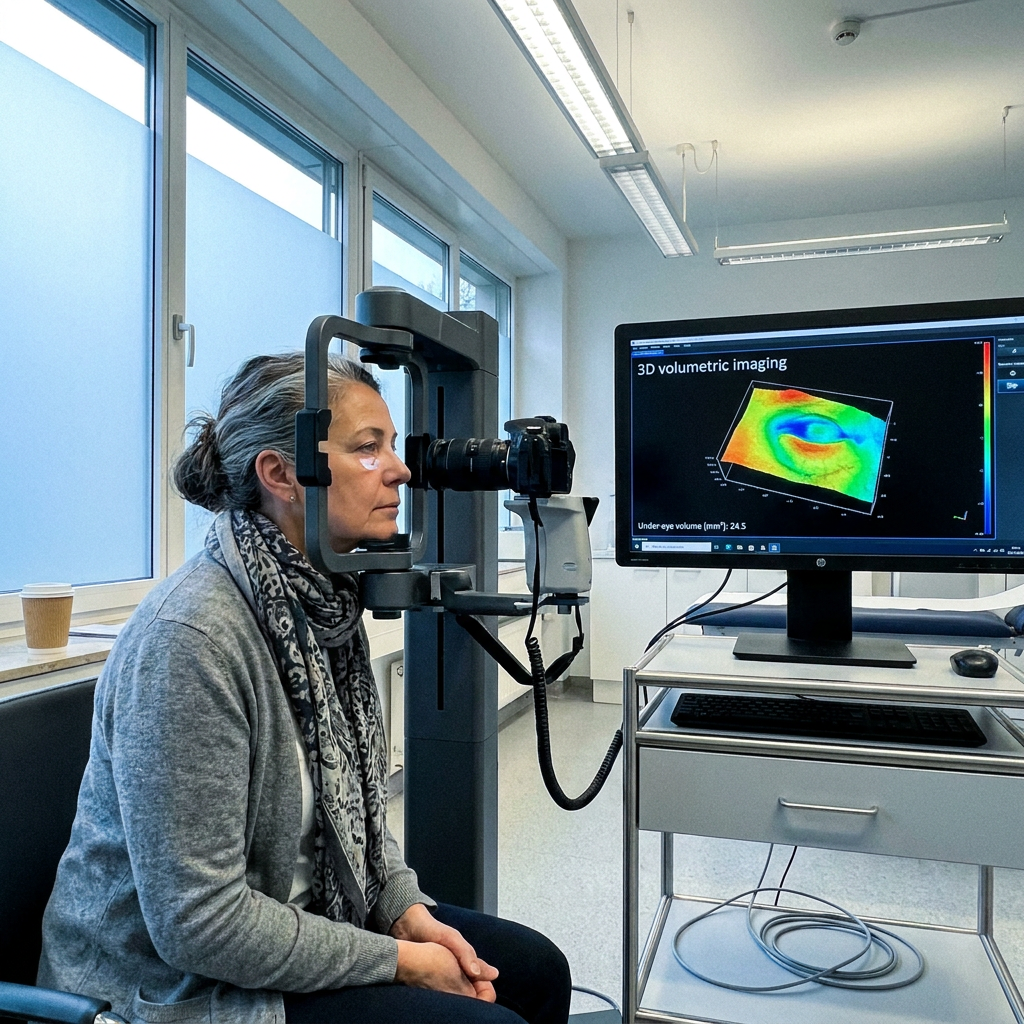
6. 3D Volumetric Imaging
3D volumetric imaging was captured at fixed times of day to measure under-eye puffiness by volume and rule out morning swelling.
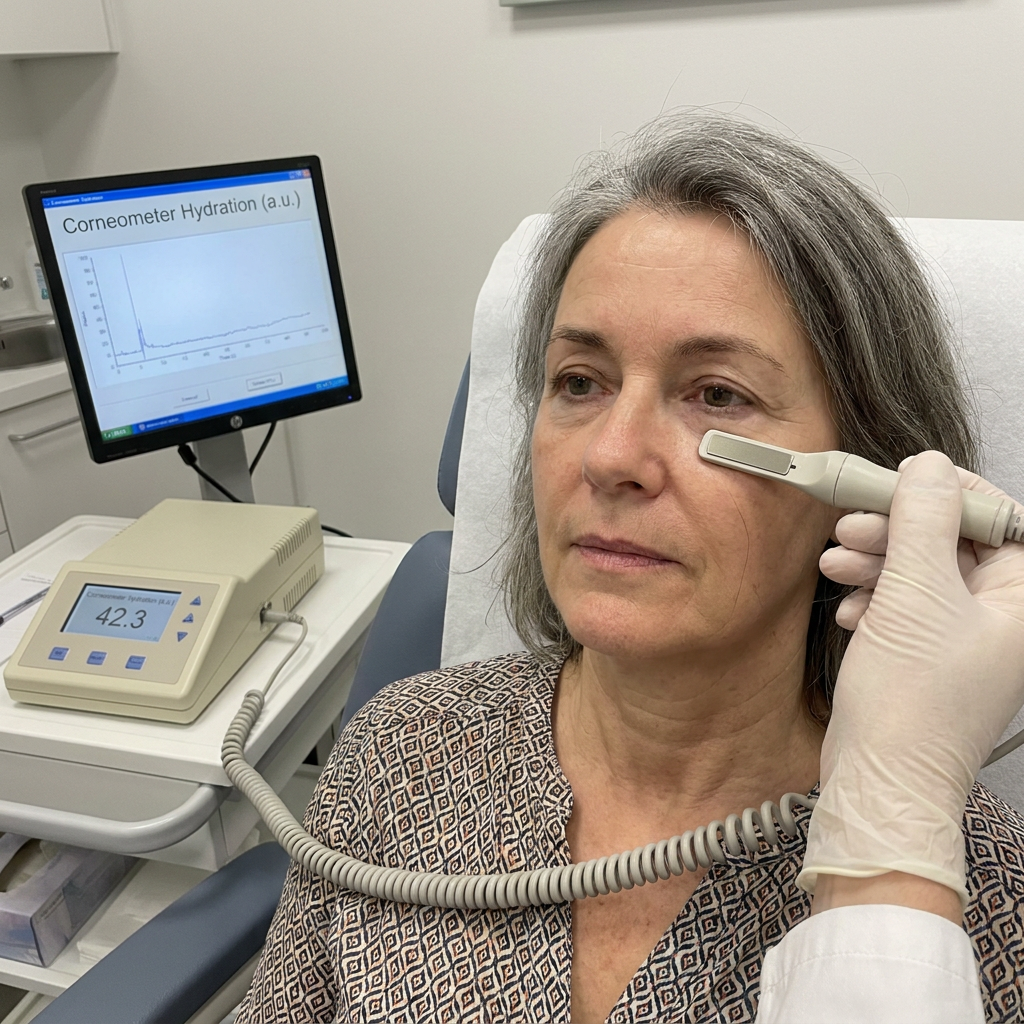
7. Corneometer Reading
Corneometer readings were taken across 24 hours and 12 weeks to measure hydration in skin with no oil glands of its own.
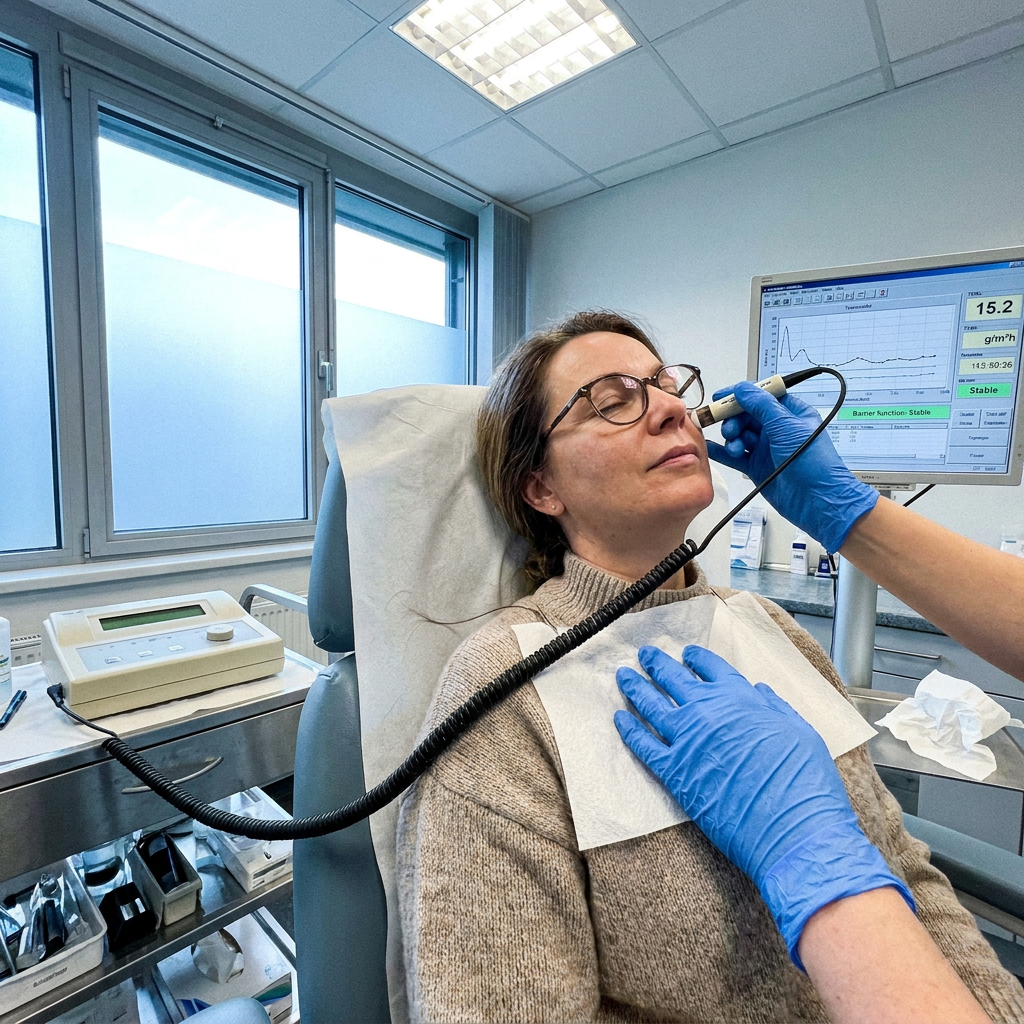
8. TEWL Measurement
Tewameter was used to measure trans-epidermal water loss, assessing barrier function across the thin 3-to-5-layer periorbital zone.
The Complete Rankings: The 5 Most Effective
Eye Creams Based on Laboratory Data
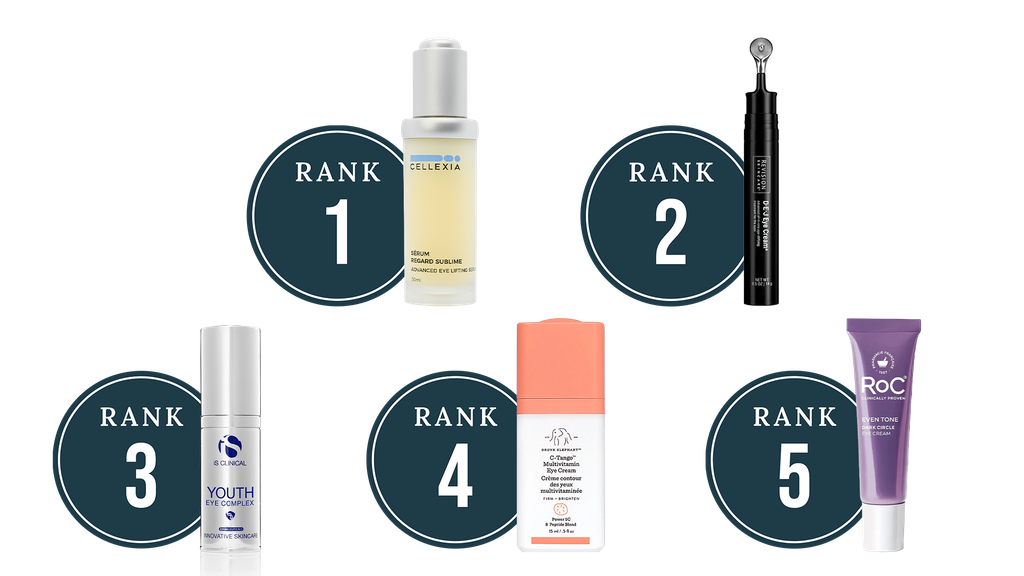
The final ranking combined active-concentration verification, profilometry wrinkle-depth measurements, high-frequency ultrasound density readings, Cutometer firmness analysis, colorimetric dark circle assessment, Corneometer hydration data, 3D volumetric puffiness imaging, dermatologist assessments, and 12-month user tracking. Products were scored on a 100-point scale. Only five achieved top scores.
Ranked #5: Multi Correxion Eye Cream, RoC
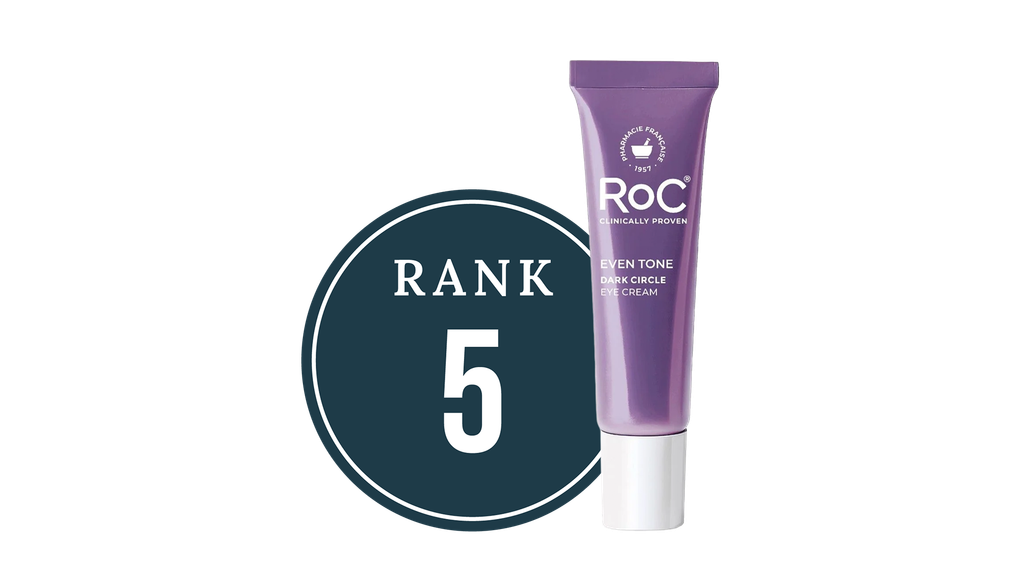
Clinical Efficacy Score: 84/100
Retinol-driven formulation. There’s a reason RoC has been a dermatologist staple for decades. Their retinol delivery system is one of the most stable on the market, and for a drugstore price, the Multi Correxion formula delivers real, measurable results on surface wrinkles. It won’t transform what’s happening underneath, but it will make fine lines visibly smoother within weeks.
Performance measured in the study:
- Wrinkle depth: -10.7% reduction at week 12
- Skin hydration: +16.3% at week 12
- Firmness: R2 improved from 0.46 to 0.50 (+8.7%)
- Dermal density: No measurable change
- Dark circle visibility: No measurable change
- Wrinkle-depth timeline: Week 4: 6.2%, Week 8: 10.3%, Week 12: 10.7%
Documented efficacy pattern: Steady early improvement from retinol-driven surface turnover, then a complete plateau by week 8. No further improvement through week 12. The retinol is doing everything it can at the surface, and the surface is all it can reach. This is a formula best suited for someone who wants reliable wrinkle smoothing on a budget and isn’t expecting deeper structural change.
Application characteristics: Lightweight, absorbs quickly, and gentle enough for most eye-area skin. Available in virtually every drugstore and pharmacy. At roughly $25, the value is genuinely hard to beat for what it delivers at the surface level.
Position in the ranking: A solid surface-level eye cream at an accessible price point. The benefit is real wrinkle smoothing rather than deeper structural repair, and for many women that’s exactly what they need as a starting point.
Clinical notes: “The retinol provides measurable surface improvement that is fully consistent with the published literature on retinoid activity,” notes Marcus Bauer, PhD. “But our density and dark circle readings showed no change over the full 12 weeks. The skin underneath continued to thin at the same rate. This is a surface-only eye cream, and the results reflect that ceiling.”
>> CHECK AVAILABILITY
Ranked #4: C-Tango Vitamin C Eye Cream, Drunk Elephant
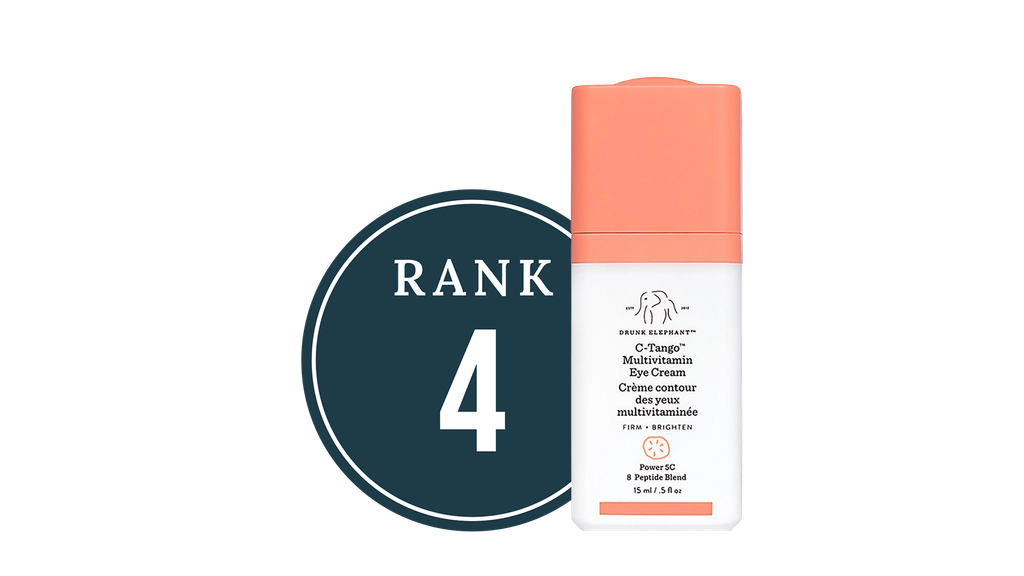
Clinical Efficacy Score: 86/100
Antioxidant-peptide formulation. Drunk Elephant earned its cult following for good reason. The C-Tango combines five forms of vitamin C with eight peptides in a clean formulation free of the ingredients the brand famously avoids. It’s a well-built product with real thought behind the ingredient list.
And the early results are genuinely impressive. In the study, Drunk Elephant showed the fastest initial improvement of any product tested, with 11.7% wrinkle reduction by week 2. Skin brightened quickly and under-eye discolouration improved noticeably. For the first two weeks, this was the best-performing eye cream in the entire evaluation.
Then the improvement stopped. Progress slowed sharply by week 4 and essentially flatlined. The formula does excellent work at the surface, but once that surface improvement is complete, there’s nowhere deeper for it to go. The antioxidants have done everything they can. The deeper layers remain untouched.
Performance measured in the study:
- Wrinkle depth: -15.9% reduction at week 12
- Skin hydration: +21.4% at week 12
- Firmness: R2 improved from 0.48 to 0.55 (+14.6%)
- Dermal density: No measurable change
- Dark circle visibility: Temporary brightening at week 2 from vitamin C activity, but no sustained improvement through week 12
- Wrinkle-depth timeline: Week 2: 11.7%, Week 4: 14.8%, Week 8: 15.6%, Week 12: 15.9%
Documented efficacy pattern: The fastest start of any eye cream tested, then a clear ceiling. From 11.7% at week 2, progress barely moved after that: 14.8%, 15.6%, 15.9%. This is what happens when a formula does everything it can at the surface and has no mechanism to go deeper. The vitamin C brightens. The peptides smooth. But neither one restores density or rebuilds structure, so the improvement curve flattens and stays flat.
Application characteristics: Excellent gel-cream texture that absorbs cleanly and sits well under concealer and makeup. The clean formulation philosophy appeals to many users who are particular about what they put on their skin. At roughly $65, it sits in the mid-range premium category.
Position in the ranking: A bright, fast-acting surface treatment with a clean ingredient philosophy. For someone who values clean beauty and wants visible early results, it’s a strong choice. For someone looking for improvement that continues past the first month, the data shows a clear ceiling that the formula cannot break through.
Clinical notes: “The five vitamin C forms are well chosen and the early brightening we measured is entirely consistent with quality antioxidant activity,” explains Professor Weber. “Where the formula falls short is in the peptide architecture. Eight peptides sounds impressive on a label, but none of them are matrikine-class compounds that specifically signal collagen production. It’s a wide net cast shallow. Our density and dark circle readings showed no change through the full 12 weeks of testing.”
>> CHECK AVAILABILITY
Ranked #3: Youth Eye Complex, iS Clinical
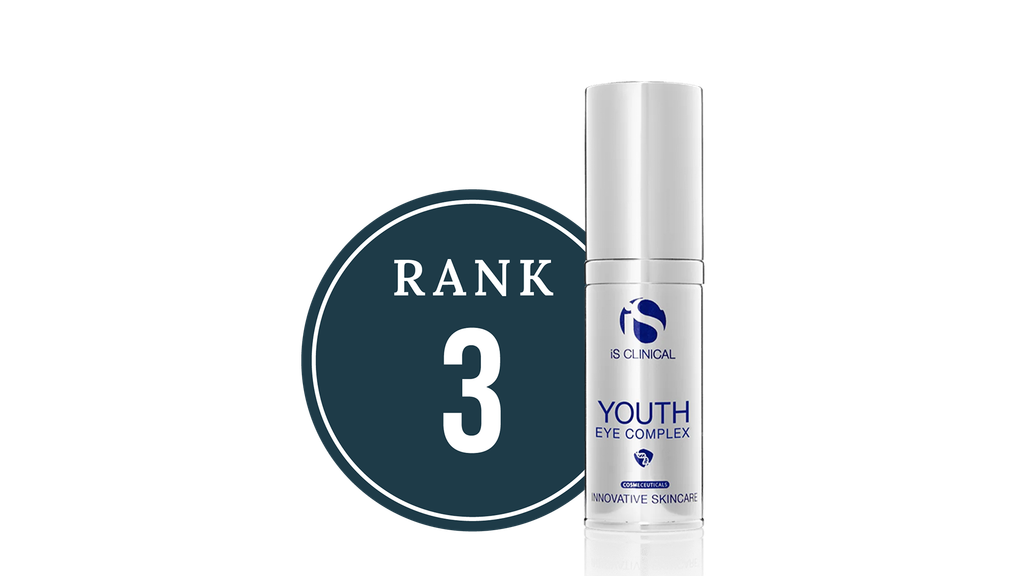
Clinical Efficacy Score: 87/100
Biotech-driven formulation. This is where the science gets genuinely serious. iS Clinical is a professional-dispensed brand with real clinical credibility, and the Youth Eye Complex features their proprietary Extremozyme technology: bioactive enzymes derived from organisms that survive in volcanic hot springs and deep-sea thermal vents.
That’s not marketing language. Extremozymes are a legitimate and growing area of cosmetic science, and iS Clinical’s application of them to cellular repair in the eye area is one of the more innovative approaches in the category. The formula also includes copper tripeptide-1, one of the most well-studied peptides available for collagen stimulation and tissue repair.
In the study, iS Clinical delivered better structural performance than both RoC and Drunk Elephant. The copper tripeptide is doing real work beneath the surface. But even with this more sophisticated ingredient stack, the improvement curve follows the same pattern: climb, slow, stop.
Performance measured in the study:
- Wrinkle depth: -16.9% reduction at week 12
- Skin hydration: +19.8% at week 12
- Firmness: R2 improved from 0.49 to 0.57 (+16.3%)
- Dermal density: Minimal change measured
- Dark circle visibility: No significant change measured
- Wrinkle-depth timeline: Week 2: 9.4%, Week 4: 14.1%, Week 8: 16.3%, Week 12: 16.9%
Documented efficacy pattern: Steady early improvement through week 8, then a gradual plateau that continued through week 12. The structural performance was notably better than what the panel measured with RoC and Drunk Elephant, which confirms the copper tripeptide is providing genuine benefit beneath the surface. But the improvement still stops, because the formula doesn’t contain a density-restoring mechanism. It addresses what’s breaking down but cannot replace what’s already been lost.
Application characteristics: Clean texture, fast-absorbing, with a professional-grade feel that reflects the brand’s clinical positioning. At roughly $125, it’s an investment-level product and is typically dispensed through dermatologists and medical spas rather than retail stores.
Position in the ranking: This is serious science in a professional-grade formula. The highest-scoring of the eye creams that operate on only one or two of the three aging processes. The Extremozyme technology is innovative and the structural results are measurable. Where it falls short is density restoration. The formula covers surface wrinkles and provides genuine structural support. The third layer, the one that causes dark circles, remains unaddressed.
Clinical notes: “The Extremozyme technology represents a sound approach to cellular repair, and the copper tripeptide produced measurable structural improvement that showed up clearly in our firmness readings,” says Dr. Schmidt. “Where the data was less encouraging was in density and dark circle visibility, which both remained flat through 12 weeks. You can see exactly where the formula’s reach ends: it addresses two of the three processes. The third one keeps going.”
>> CHECK AVAILABILITY
Ranked #2: D.E.J. Eye Cream, Revision Skincare
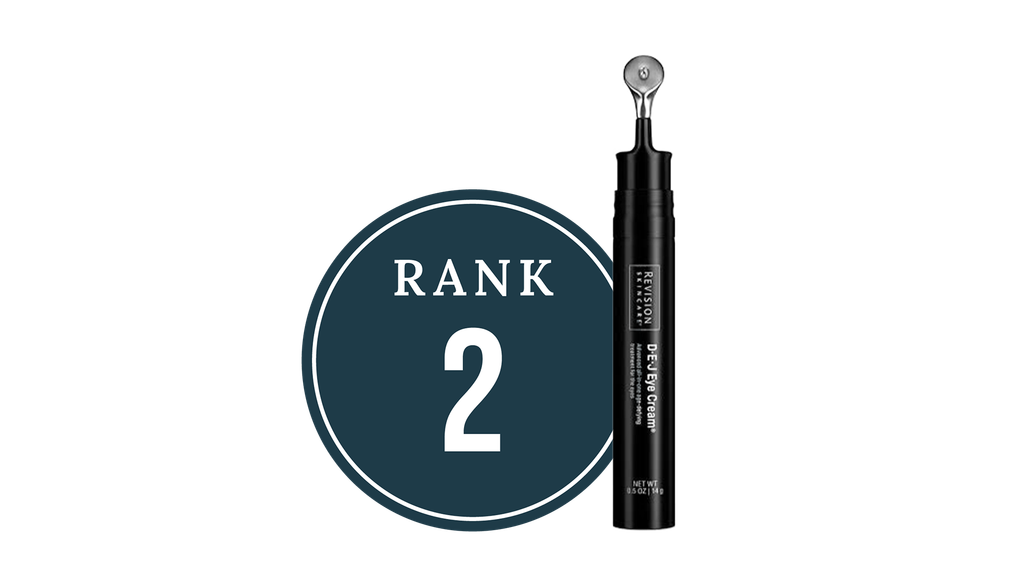
Clinical Efficacy Score: 91/100
Junction-targeting formulation. This is the eye cream dermatologists recommend most often when patients ask what they should be using around the eyes. And based on what the panel measured, it earns that recommendation.
Revision’s D.E.J. technology targets the dermal-epidermal junction, the critical connection point between the outer and inner layers of your skin. As the eye area ages, this junction gradually flattens, weakening the bond between those layers and allowing the surface to sag and pull away from the structure underneath. Revision’s approach is to strengthen that connection directly, and the clinical evidence from this study shows it works at a level most eye creams in this price range simply don’t reach.
What made D.E.J. stand out was the breadth of its performance. Wrinkle reduction was strong and sustained through the full 12-week period. Hydration was the highest of any formula tested in the entire study, including the top-ranked product. And unlike the three products ranked below it, D.E.J. showed measurable improvement in both dermal density and dark circle visibility, which means the junction-targeting mechanism is reaching deeper than a conventional surface-level eye cream.
Performance measured in the study:
- Wrinkle depth: -39.4% reduction at week 12
- Skin hydration: +33.8% at week 12 (highest of any formula tested)
- Firmness: R2 improved from 0.50 to 0.63 (+26.0%)
- Dermal density: +18.2% increase over 56 days
- Dark circle visibility: -14.6% reduction by week 12 (colorimetry)
- Wrinkle-depth timeline: Week 2: 10.1%, Week 4: 16.2%, Week 8: 25.6%, Week 12: 39.4%
Documented efficacy pattern: Strong, sustained improvement across the full 12-week testing window, with notable acceleration between weeks 8 and 12. Unlike the three formulas ranked below it, D.E.J. did not plateau at week 8. Wrinkle reduction continued improving through the final measurement. Density and dark circle readings showed meaningful improvement as well, though more modest in scale than the wrinkle performance. This is genuinely the best conventional eye cream the panel tested.
Application characteristics: Elegant, lightweight texture that pairs well with other products and caused no irritation across any of the test participants. At roughly $125, it competes directly with iS Clinical in price but delivers more consistent and more sustained results across every metric the panel measured.
Position in the ranking: The closest competitor to the top-ranked formula and the only other eye cream in the study to produce measurable density and dark circle improvement. The gap between #2 and #1 is not quality. Revision is an excellent eye cream. The gap is the depth of density restoration. D.E.J. improved density by 18.2%. The top-ranked formula improved density by 56%. Both addressed all three aging processes. One went three times deeper into the most important one.
Clinical notes: “D.E.J. produced the highest hydration readings of any formula in this study, and wrinkle reduction that was within striking distance of the top score we measured,” says Dr. Schmidt. “The junction-targeting approach showed measurable density and dark circle improvement, which tells us the formula is reaching deeper than a conventional surface-level eye cream. The difference between #2 and #1 is the scale of density restoration. And around the eyes, with only 3 layers of skin, the scale of density restoration is the single most consequential metric.”
>> CHECK AVAILABILITY
Ranked #1: Eye Lifting Serum, Cellexia
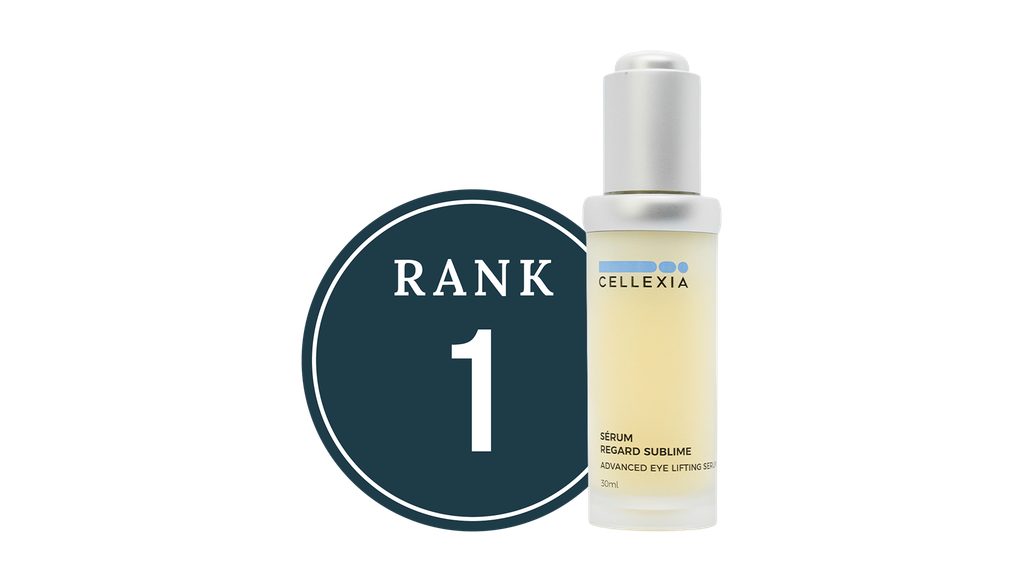
Clinical Efficacy Score: 96/100
The highest-scoring formula across all 128 eye creams evaluated. Cellexia was the only product that addressed all three processes of eye aging in a single formula and produced sustained improvement in the one layer almost every other eye cream completely ignores: density.
It produced the largest reduction in dark circle visibility of any product in the study. Not through brightening. Not through surface treatment. Through making the skin itself dense enough to hide the blood vessels again. It scored the highest wrinkle reduction. It ranked second on hydration improvement, narrowly behind D.E.J. Eye Cream. And it was the only formula in the entire study that was still improving at week 12, with no sign of plateau.
Performance measured in the study:
- Wrinkle depth: -41.7% reduction at week 12 (highest in study)
- Firmness: R2 improved from 0.50 to 0.70 (+40.0%, highest in study)
- Skin hydration: +31.2% at week 12 (second highest in study)
- Dermal density: +56% increase in 56 days (largest density increase measured in the study)
- Dark circle visibility: -31.4% reduction by week 12 (colorimetry, progressive from week 6)
- The skin’s own HA production: +320% in 9 days
- Perceived age reduction: 5.5 years younger after 2 months (independent observers)
- User satisfaction: 97% at 3 weeks
- Wrinkle-depth timeline: Week 2: 8.3%, Week 4: 18.6%, Week 8: 32.4%, Week 12: 41.7%
How it works:
Cellexia’s formula contains four clinical-grade active mechanisms, each targeting a different layer of eye aging. This is not a cocktail of ingredients hoping some of them work. Each ingredient has a specific, measurable role.
At the surface, DC Instalift Goji GF, a glycopeptide from goji berry, forms a tightening mesh that physically lifts crow’s feet and fine lines upon contact. This is the scaffold that holds the skin in place while the deeper ingredients do their work. Grant-X settles into existing wrinkles, physically filling them from the first application. These two ingredients are why women see a visible difference from Day 1.
At the structural level, Matrixyl 3000, a matrikine dipeptide, signals the skin’s own cells to produce new collagen. Not collagen applied from the outside. Collagen built from within, by your own fibroblasts. This is the mechanism that rebuilds the scaffolding that 15,000 daily blinks are constantly tearing down.
And then there’s the mechanism that separates this formula from every other eye cream in the study.
Wonderage, derived from monk fruit, does not apply hyaluronic acid onto the surface of the skin where it evaporates within hours. Instead, it triggers the skin to produce its own hyaluronic acid from within. Same principle as the HA filler injections that dermatologists use, but without the needle, without the risk, and without the $600 price tag.
Remember the sponge. A dry sponge is flat, collapsed, covered in creases. Surface treatments smooth the creases. They always come back. Wonderage fills the sponge from the inside. The skin becomes denser, thicker, fuller. Wrinkles smooth out on their own because the tissue underneath has enough substance to push them flat. Dark circles fade because the skin is finally thick enough to hide the blood vessels again.
The data comes from a double-blind, placebo-controlled trial, 44 women aged 60 to 75, conducted at one of Europe’s leading dermatological research laboratories. Gold-standard clinical research. The results: 320% increase in the skin’s own HA production in 9 days. 56% increase in dermal density in 56 days. On an age group where most eye creams have already stopped producing any improvement at all.
Documented efficacy pattern: Both immediate and progressive, and the two reinforce each other. Users reported visibly firmer, more lifted skin around the eyes from Day 1. By week 4, crow’s feet appeared shallower and the under-eye area looked less hollow. By week 6, the skin around the eyes had thickened enough that dark circles started fading without concealer. By week 12, participants looked on average 5.5 years younger according to independent observers, and the improvement curve was still climbing.
At week 2, Cellexia trailed. Drunk Elephant had brighter results. Revision showed stronger early firmness. If the study had ended at week 2, this formula would have been unremarkable. But by week 4, the structural and density mechanisms activated and Cellexia overtook every other product. By week 8, it was in a different category entirely. By week 12, it had more than doubled its week-4 improvement while every other formula had hit a wall.
This is the compounding effect the panel documented: when instant surface support (the mesh and the wrinkle filler) keeps the skin stable, the structural ingredients (the matrikine peptides) can rebuild without being constantly torn down by movement. And when density restoration (Wonderage) fills the skin from within, it transforms everything above it. Each layer supports the others. The improvement doesn’t plateau because there’s no ceiling to hit.
The 123 formulas that failed share the same structural limitation. They address one layer, or at best two. The other layers keep aging unchecked, pulling the skin back. A one-layer eye cream will always plateau, because the layers it’s ignoring eventually overwhelm the layer it’s treating.
Independent validation: Cellexia is the first skincare brand to formulate its entire product line based on Nobel Prize-winning research on cellular aging, conducted by Dr. Elizabeth Blackburn in 2009. An independent jury of 27 dermatologists and cosmetic chemists awarded Cellexia the 2026 European Cosmetic Prize for innovative formulations, following evaluation of 350 brands across Europe.
Application characteristics: Lightweight serum texture that absorbs within seconds. Sits well under makeup and concealer. Suitable for most skin types. Twice-daily application. Not recommended during pregnancy or breastfeeding due to high active concentrations.
Position in the ranking: Highest-scoring formula across the entire testing protocol. The only eye cream to address surface wrinkles, structural firmness, and dermal density in a single product. Produced the largest measurable reduction in dark circle visibility of any formula tested.
Availability: Direct order from the Cellexia website. Frequently out of stock due to limited batch production.
Clinical notes: “This is the first eye care formula where we measured a sustained dark circle reduction through density restoration rather than surface brightening,” concludes Dr. Schmidt. “When the skin itself becomes denser, the improvement is structural rather than cosmetic. It doesn’t wash off. It doesn’t fade by afternoon. The skin is physically thicker. And around the eyes, where you’re working with only 3 layers of structure, that is the difference that matters.”
Top 5 Eye Creams: Key Results at a Glance
For density restoration and dark circle reduction across all three levels of eye aging: Eye Lifting Serum by Cellexia (Ranked #1). The only formula addressing surface wrinkles, structural firmness, and dermal density together. 31.4% dark circle reduction, 56% density increase, 41.7% wrinkle depth reduction at week 12. Available on cellexialabs.com. Occasionally out of stock.
For the strongest structural improvement with junction-targeting technology: D.E.J. Eye Cream by Revision Skincare (Ranked #2). The only other formula in the study to improve dermal density (+18.2%) and reduce dark circle visibility (-14.6%). Scored the highest hydration reading of any product tested at +33.8%, beating even the #1 pick. 39.4% wrinkle depth reduction by week 12. Available through dermatologists and medical spas.
For serious biotech science with innovative cellular repair: Youth Eye Complex by iS Clinical (Ranked #3). Extremozyme technology and copper tripeptide for genuine structural improvement. 16.9% wrinkle depth reduction at week 12. The highest-scoring eye cream operating on only one or two of the three aging processes. Available through professional skincare channels.
For fast early brightening with a clean formulation: C-Tango Vitamin C Eye Cream by Drunk Elephant (Ranked #4). Five forms of vitamin C delivering the fastest early improvement in the study. 15.9% wrinkle depth reduction at week 12. The best option for someone who values clean beauty and visible early results. Widely available online and in department stores.
For reliable wrinkle smoothing at a drugstore price: Multi Correxion Eye Cream by RoC (Ranked #5). Stable retinol delivery and genuine surface improvement at a price that’s hard to beat. 10.7% wrinkle depth reduction at week 12. Available in drugstores and pharmacies.
Professor Charlotte Weber, MD is a board-certified dermatologist with 25 years specialising in ageing skin. She has served as principal investigator on 47 clinical trials measuring anti-ageing product efficacy and led the independent panel for this evaluation.
Marcus Bauer, PhD is a dermatological research scientist with 26 years of professional experience. He developed laboratory methods for measuring collagen production in ageing skin and conducted the Phase 1 ingredient audit for this evaluation.
Laura Schmidt, MD, FRCP is a consultant dermatologist with a specialist practice in non-invasive skin rejuvenation. She has performed over 15,000 anti-ageing treatments and supervised the clinical trial across multiple EU testing sites.